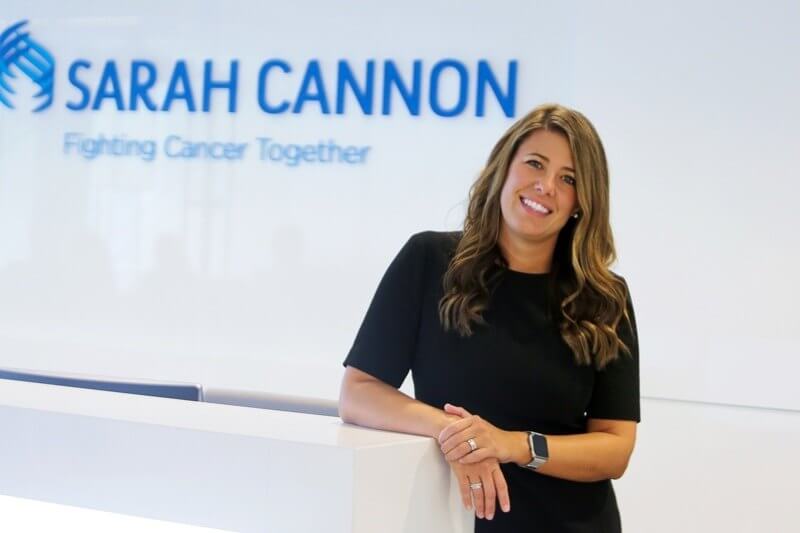
Samantha Kirby has perspective. She's been a patient in the same boat as those she serves every day in her role at the Sarah Cannon Cancer Institute at TriStar Health. Meet our newest FACE of TriStar.
In May, Samantha Kirby, Regional Vice President for Sarah Cannon Cancer Institute at TriStar Health, checked in to TriStar Centennial Women’s Hospital for a routine laparoscopic hysterectomy. But she awoke from surgery to some disconcerting news: her gynecologist found a tumor. Though the tumor initially looked to be attached to her uterus, doctors later discovered it was wrapped around her colon. They decided she needed a colonoscopy to determine whether the tumor had invaded the colon, so they scheduled surgery for the following week to remove the uterus, as well as the tumor, and perform additional work on the colon if necessary. The Friday colonoscopy revealed the tumor had not invaded the colon, so Sam went home for the weekend and returned for surgery on Monday. This time, she awoke to better news. They’d successfully removed the uterus and the tumor without having to operate on the colon. Still, she had to wait for the biggest news of all: Did she or did she not have cancer? Three days later, she got the answer everyone wants to hear — the tumor was benign. We talked to Sam, our latest FACE of TriStar, to find out more about Sarah Cannon, her position there, and what it’s like to be on the receiving end of the oncology processes she works to make as seamless and painless as possible for patients who enter TriStar’s doors. Welcome Sam as our newest FACE of TriStar!PinSamantha Kirby is this month’s FACE of TriStar.
What does your job entail?
I’m responsible for the cancer service line for all of TriStar Health. So, I work for Sarah Cannon, which is the cancer institute at HCA Healthcare, of which TriStar is a part. I work on initiatives related to cancer from all aspects of a patient’s journey, serving communities across Middle Tennessee, Southern Kentucky, Chattanooga and Georgia. From the very beginning when they need to be screened — whether it’s mammography, colonoscopy, lung screening — we ensure that we provide access to those services in the community. We are ensuring that in each part of a patient’s journey, whether it’s from diagnosis through treatment and beyond, we provide the right resources and the best physicians, so the patient feels like it’s a seamless process and not fragmented. Nurse navigation is a key part of that. Our nurse navigators are trained specifically in oncology and walk with patients through every part of their journey. In my role, I work with each of our Sarah Cannon programs within our TriStar hospitals to make sure each patient has the personalized care that they need close to where they live — whether it is a strong lung screening program in Dickson where lung cancer instances are high, or access to the latest treatment for a specific type of cancer. Our services include everything from surgery to radiation oncology to world-renowned cancer research through our Sarah Cannon Research Institute partnership. That’s really my job in a nutshell, for 14 hospitals across three states — Kentucky, Tennessee and Georgia.
Pin
Talk about Sarah Cannon and what it has to offer patients.
One of the most amazing things we do that you don’t always have in a community setting is the level of multidisciplinary communication and collaboration. Very rarely is a patient treatment decision made by one physician. I would say that actually never happens. We are so connected from a physician standpoint, an administration standpoint, and a navigation standpoint that the top of mind is always about how to make and put together the best plan for each individual patient, not cookie cutter. And that’s really hard to pull off. When you’re talking about 5,000+ cancer diagnoses that move through the TriStar Health system annually, but tailoring each plan to each individual, and that’s just something that you would more typically see in an academic setting. Our multidisciplinary team comes together and discusses all the patients and plan together. The coordination that it takes to make that plan happen, not just from the physician side but the navigation piece, is challenging, but I would say that’s probably one of the best things we do. I think the other thing is the accessibility to world-class research. You have more research opportunities at TriStar Health through Sarah Cannon for some tumor types than you do in any of the academic settings, and people don’t really realize that.
Pin
What did you take away from your experience as a patient at one of your hospitals?
It very much put me in the place of where our patients are, getting to experience this setting from the patient’s perspective was a good level set for me. I’ve worked in oncology for almost a decade, and over time, things just become normal, and hearing the word cancer every day is just what I do. Being in that situation, I went through all those emotions and all the experiences that our patients have to move through every day — it was very eye opening. I was inspired. When I walked in the hospital the first day to registration, the girl who registered me was upbeat, and we were talking about how I was ready for the surgery and excited to get it over with. She was also the same one who registered me for the colonoscopy that same week, and she said, “Wait a minute what are you doing here?” I was able to tell her a little about my story, and she said, “I have a peace about this for you, and it’s going to be OK.”
I went back for the colonoscopy and the nurse came in and asked, “Are you OK?” I told her my story. I started to get tears in my eyes, and she sat down on my bed and put her arms around me and said, “I’m going to pray with you. Is that OK?” And we did. The next person was the anesthesiologist, who I knew personally from my work at Sarah Cannon, and he said, “What are you doing in that bed?” I repeated my story, and he said, “Well let me tell you, you’re in the right spot. We have the most capable and best hands, and we are going to take care great care of you.”
They all loved on me and reassured me, even though we didn’t know what the outcome was going to be. Everybody was present and in the moment just for me right when I needed them to be, and it continued when I had the second surgery on that Monday. Everyone was gentle and meeting me right where I was with what I needed. I know I got good news; I was told I didn’t have cancer. Our patients are often told the opposite of that, but I feel like the care that is delivered, regardless of your situation, is so attentive to you as an individual.
Pin
How did this scare impact you personally?
I really felt like I had a new lease on life. It’s hard to get discouraged when you’re stressed now, because it’s like, Hey, I’m good. I feel so positive, and I just feel better after getting all that stuff out of there. I think that’s part of the message too. As women, we are so busy caring for everybody else around us. We know we should take better care of ourselves, but we just don’t take the time. Maybe we are also scared of what they are going to tell us. I had been putting off having this surgery that was causing me a lot of discomfort and pain because I was worried, and I didn’t want to take the time to care for myself. I knew it would take me away from work for some time. I have a 12-year-old daughter who is very active with her school, and my husband owns a business. We just live very busy lives, so there’s never a good time to just to pause to care for yourself. There’s a saying that you can’t pour from an empty cup, and that is so true. I really had emptied my cup completely. I came back from this experience renewed and grateful for our care team, who are probably dealing with similar things in their own lives, but they took the time to get me through that kind of crisis. When the opportunity to work at Sarah Cannon opened up three years ago, it was perfect. I had found my calling, and I think this experience just renewed that.
Pin
What advice do you have for women who might be putting off that routine medical test or exam?
The sooner you find out what’s going on with you is always going to be better. So, the more you delay, the more opportunity for things to get out of control. The earlier we find cancer — or anything — the better the intervention, the better the outcome. Schedule your mammogram like getting a manicure or a pedicure, and schedule a lunch with girlfriends with some wine afterwards. I cannot tell you how many people don’t get their colonoscopies, and it’s actually the only test we can do to prevent [colon] cancer. With a colonoscopy, if we find a polyp, we go ahead and get it out of there and then it doesn’t become cancer. That’s amazing!
Thanks to Samantha Kirby for sharing her journey. Learn more about Sarah Cannon at TriStar Health, visit tristarhealth.com. FACES of TriStar is sponsored by TriStar Health. Photography by Grannis Photography.
Our unofficial motto at StyleBlueprint is "Be kind. Do good." We encourage this to be the basis for all comments on our articles. Provide feedback that adds to the story. Some controversy or disagreements are part of any good dialogue between friends, but anything that tears down or belittles others is subject to disapproval or removal. Thank you for being a member of the StyleBlueprint community! View our Community Guidelines.