Meet Celebrated KY Designer and Basket Weaver, Emily Ridings
Meet Emily Ridings, the young Kentucky fashion designer and weaver turning an age-old craft into modern magic. Her work has caught the eye of major designers and magazines and stolen the hearts of onlookers around the world! Image: Ayna Lorenzo
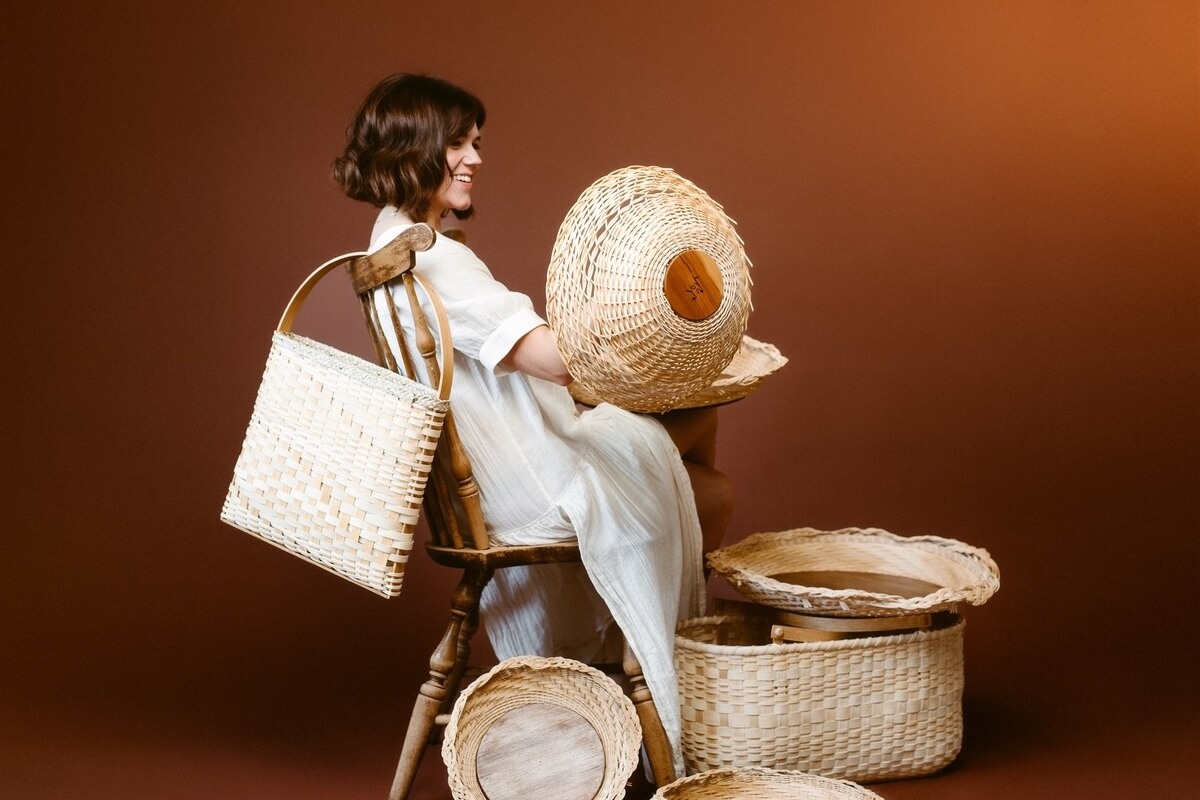
Emily Ridings is a Kentucky-based fashion designer and basket weaver with a knack for turning age-old crafts into modern magic. She got her start weaving baskets with her grandmother. She graduated from Pratt Institute with a BFA in Fashion Design and an arsenal of head-turning pieces, like her thesis pièce de résistance, an oversized bamboo reed hoop skirt. From her Lexington studio, Emily brings ancestral techniques into the now, weaving everything from baskets and vases to jewelry and scarves with natural fibers like seagrass and bamboo cane. Meet our newest FACE!

Tell us about your younger years. How did the people and culture of Kentucky nourish your creativity?
This question first sparks gratitude to my parents for always encouraging my creativity. They weren’t pushing me into sports over art. And we traveled a lot compared to the average kid in Richmond, Kentucky. I went to New York for the first time when I was eight and knew I wanted to be there. Growing up in the early 2000s, pop culture was filled with ROM-coms of women living in big cities. I always wanted an artistic career, so I chose Pratt in New York.
I didn’t grow up with an immense appreciation of where I was from. I mostly wanted to leave. But soon into my time in New York, I started coming home and noticing, “Oh, nature’s cool. Space is cool. A slower pace is cool.” While I was getting to the root of my process and my values at Pratt, I started paying closer attention to handmade crafts. The South and Kentucky have such rich history in Appalachian craft. So, I came back to things that I never really cared about, like our field trips to Berea to see the artisans. Now, I highly value where I’m from. But it took getting away and getting some perspective.
How did your grandmother nudge you toward basket weaving?
I made a couple of baskets with her early on because she said, “Let’s do this,” and not because I really wanted to. She’s always had so many practical skills. We sewed things together. She made our Halloween costumes. Growing up, I always knew I could make the things I wanted. I do that with all kinds of things now, like trying to restore furniture or reassembling jewelry — anything that seems broken or isn’t quite how I want it to be, I know that I can ask, “What can I do with that?”

How did the iconic basket skirt come to be?
It wouldn’t have existed without my grandmother. I went to her and asked, “Can we do this?” I was scheming for my senior thesis and was interested in any handmade craft with a history. I was working with so many different kinds of materials and making shirts out of paper bags and ceramic buttons. My style for my thesis was ready-to-wear-esque, but I liked some drama. I like fantastical, fun expression. The basket skirt idea felt like such a release in my brain. It told me to go crazy. And so we did.

What factors guide your choice of materials, and how do you balance traditional, contemporary, and sustainable elements in your designs?
I love the hunt for anything, whether I’m sourcing in my personal life or for work. I rely on the resources my grandmother gave me. It’s a funny little subculture of mostly older people who are hobbyists. Sometimes, they don’t have a website, and you have to email them with your order. It’ll be interesting to see how that shifts over the next 10 or 20 years when these resources age out.

Is there a design “trend” that evokes feelings in you, good or bad?
It’s interesting to talk to makers in craft spaces right now because handmade is definitely trending, and I don’t think it will stop. It’s cool that there’s an emotional pull. Sure, bigger companies are helping encourage trends of handmade, tangible, nuanced pieces, like quilts or baskets.
But I get protective when I see it at Target, and I know this thing is still handmade when it’s mass-produced. It’s a common misconception that a machine makes it. It’s not possible. All baskets are handmade. So, it’s really a question of whether this labor was exploited. I hope that — as handmade techniques stick around — the visual authenticity of the pieces actually reflects the process of how it’s made.
What’s another common misconception people have about basketweaving?
I think a lot about the perception of craft, specifically how people value functional design versus art when I see it all as one thing. It’s interesting. Some people value my price point, and they understand it. They actually respect it more because I’m charging fairly. But the more sculptural I get, like when I make wall pieces, people are willing to pay more because they immediately perceive it as art rather than something to put your blankets in.
I’m excited about doing more fine art, but I could spend the same amount of time on two pieces, and someone would pay $2,000 more for one because they think it’s a sculpture. That’s endlessly fascinating and frustrating to me, but it’s working in my favor right now.

Can you describe your dream collaboration?
A new hotel would be a cool foundation for what it could be. I imagine a space full of my work … a woven wall, light fixtures, vessels. It culminates in an event with musicians and food, and it’s a super immersive thing where other people are making things — a whole sensory experience. I want to work with a bunch of different people and play off of them. That’s reflective of how I felt in college. I interned with chefs and at a farm because I always felt everything was connected.
Where can we find you on your days off?
I really love gardening. I’m not very skilled, but I like being out there messing around. I love vintage shopping. I live in Lexington, where UK sports run the show. Even my partner is all about it. It really emphasizes what I care about. I’ll go to a tailgate, but I’m not forcing myself to care about it.

What’s the best advice you’ve received?
Stay curious. It solves everything. Halfway through college, I was questioning the point of it all. Everything was so saturated around me … there was so much fashion and art. I didn’t know what I was going to do. When you keep questioning rather than trying to find the answer, it keeps things more lighthearted and less about ego. Answers will come if you’re doing whatever you’re drawn to do in the present.
Besides faith, family, and friends, name three things you can’t live without.
A heating pad, lip balm, and electrolytes.
LIGHTNING ROUND
Favorite recent book or podcast? The Los Culturistas podcast
Bucket list vacation destination? Greece
Favorite “hidden gem” in KY? Kentucky Native Cafe connected to Michler’s plant shop
Go-to birthday present to give? Something I make — almost always. Like a woven vase or a silk scarf.
**********
For more inspiring Southern women and their stories, visit our FACES archives!

Zoe Yarborough
Zoe is a StyleBlueprint freelance writer, Charlotte native, Washington & Lee graduate, and Nashville transplant since 2012. She teaches Pilates, helps manage recording artists, and likes to "research" Germantown's food scene.