
What’s That Glowing Line in the Sky?
Whether you know about Starlink's satellite trains or not, the glowing line in the sky is quite the sight to behold. Here's what we know about this tech phenomenon and how you can spot them. Image: Elsa Pfaff King
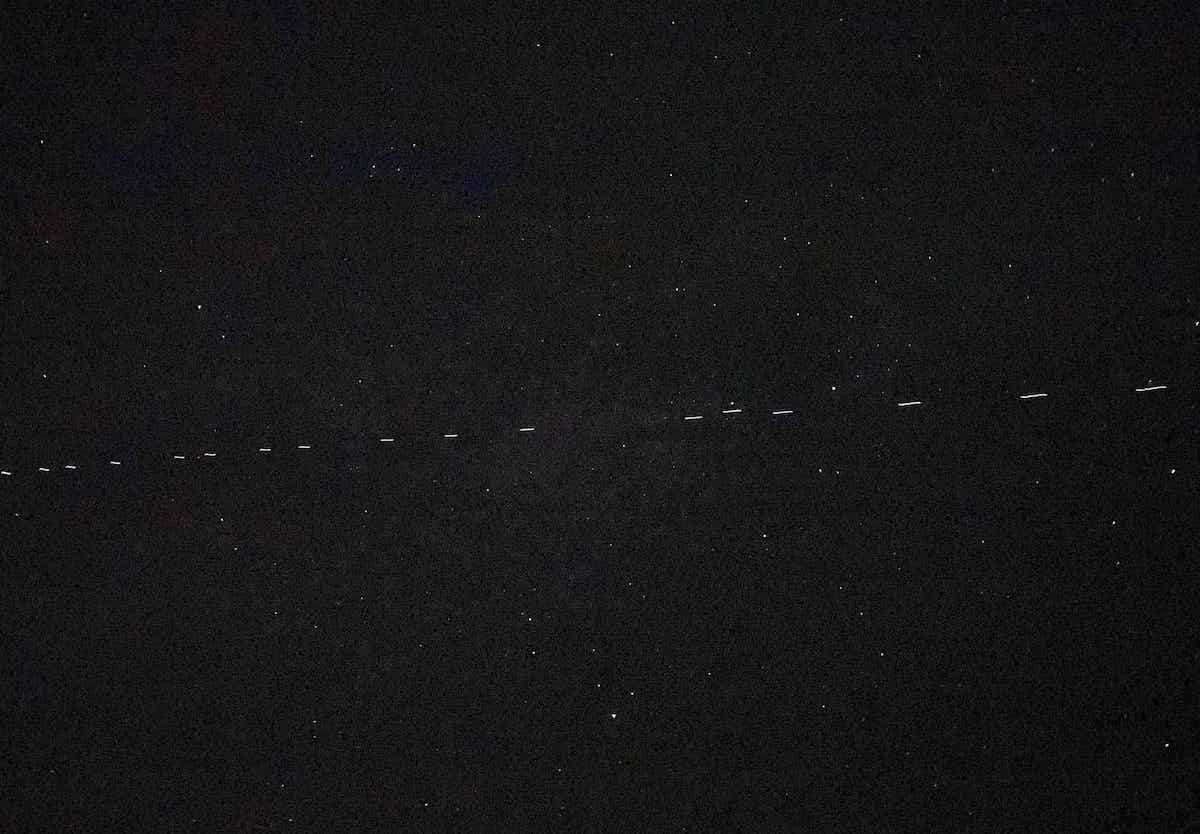
If you’ve ever looked up at the night sky and thought, “What the [bleep] is that UFO-looking glowing line in the sky moving stealthily across the starry night?” You’ve likely then shouted, “[Friend or family member’s name], YOU GOTTA COME SEE THIS!” and frantically Googled, only to find out that it’s not aliens (sadly), but one of the flashiest new additions to our modern skies: Starlink.

I recently witnessed this phenomenon on a recent trip to Lake Martin in Alabama with my in-laws over Memorial Day weekend. We were all in awe. We had no idea what we were seeing, and we also had no idea that Starlink existed. For the uninitiated, Starlink is a project by SpaceX aimed at building a massive satellite network thousands strong to deliver high-speed internet to places traditional cables and cell towers can’t reach. The goal is WiFi for the entire planet. More on the feasibility of this in a bit.
The “satellite train” phenomenon started grabbing attention around 2019, when SpaceX launched its first big batch of satellites. Instead of discreetly slipping into orbit one at a time, these suckers show up in formation, reflecting sunlight and looking a little too organized. They’re like glowing pearls on a necklace if the necklace were hurling itself across the sky at 17,000 miles per hour. That means a satellite completes one orbit around the globe roughly every 90 minutes.
People who see them for the first time often describe the display as “creepy,” “majestic,” or “a UFO sighting that made me scream in front of my neighbors.” And honestly? It’s that weird. The way they move — little bright lines gliding in a perfect, silent line — feels more like a sci-fi movie than anything nature could cook up. This YouTuber captured a fantastic video:
So, when can you see them? Timing is everything. Starlink trains are easiest to spot shortly after a new launch (SpaceX loves to launch at all hours), and typically just after sunset or before sunrise. That’s when the satellites are high enough to catch sunlight, but it’s dark enough down here to see them. You can track upcoming sightings using websites like Heavens Above or apps like Find Starlink.
Not everyone is clapping for Elon’s sky parade. Astronomers have been wary about the operation for years, arguing that the bright satellites interfere with telescopes and long-exposure images. SpaceX has responded by adding “sunshades” to reduce reflectivity, but the issue’s far from solved. Also, as satellites reach the end of their lifespan and deorbit, they can create space debris, potentially posing a collision risk to other satellites and spacecraft.
Still, Starlink is doing some good down here on Earth. It’s already bringing internet to remote villages, disaster zones, and off-grid places. So while it may look like a space train to nowhere, it’s actually delivering some pretty vital services to people who need them most. It’s helping the aid worker in a war-torn country, the nomad vlogging in their tricked-out RV, and many people in between. But Starlink is pretty expensive. The dish kit can run up to $599, then internet service ranges from $80 to $120 a month.
Have you seen the glowing satellite snake slinking across the sky? Tell us over on Instagram!
**********
Give your inbox the Southern makeover it deserves! Subscribe to our daily emails HERE!

Zoe Yarborough
Zoe is a StyleBlueprint staff writer, Charlotte native, Washington & Lee graduate, and Nashville transplant of eleven years. She teaches Pilates, helps manage recording artists, and likes to "research" Germantown's food scene.