The Trouble With Nordstroms, Krogers, Aldis & More
Do you say Krogers? What about Nordstroms? Belks? Does it make you cringe when other people do? Grammar Guru takes an entertaining look at all of the business names we mistakenly add an "s" to, why we do it, and who actually cares.
·
By
Zoe Yarborough

Why do people add an “s” to the end of so many words that don’t need it?
This is more of a Grammar Guru musing than a lesson, but it’s a worthwhile and hilarious one. The idea was sparked by an entertaining Twitter discussion on Nashville-based author Mary Laura Philpott‘s Tweet below.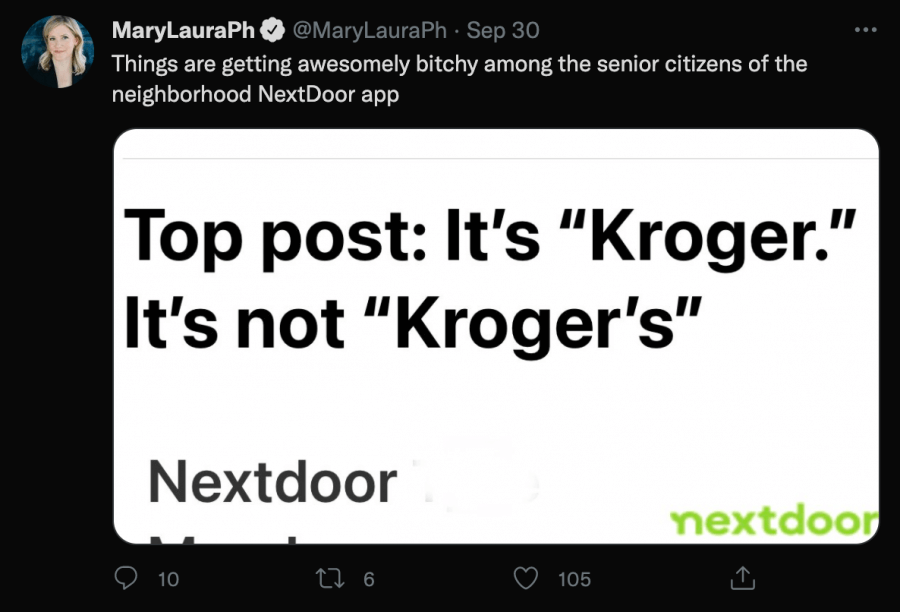
Common brands and businesses we INCORRECTLY add the letter “s” to
I asked a lot of people and did a lot of research to find businesses that people attack with an unwarranted “s” most often. I tried to write these in order of most commonly to least commonly misspelled/misspoken. I left them without any apostrophes for clarity’s sake, but will tackle that below.RELATED ARTICLE: The Nashville Author You Can Totally Relate To
Why do we do this?
This Grammar Guru/language lover believes it’s a combination of these three phenomena. REASON 1: This is a concept carried over from the past, which is why older generations do it more than the younger ones. Department stores, food markets, and restaurants have a long history of being named after their founders and taking on the possessive form. In a Southern Living article on department stores of the past, the majority of the 19 stores mentioned end in “s” and most of those are possessive names: Rich’s, Loveman’s, Davison’s, Foley’s, Joske’s, Neilson’s, Gayfers (which was originally Gayfer’s but dropped their apostrophe in 1970), Ivey’s, McRae’s, Burdine’s, Furchgott’s, Tapp’s… the list goes on. Almost all the places my grandparents’ generation patronized had a single person’s name or a family name behind them. The Meijer grocery chain in the Midwest was once “Meijer’s Thrifty Acres,” so locals say “Meijer’s” constantly. REASON 2: Many businesses that we frequent end in “s” or the “s” sound. Whole Foods, Trader Joe’s, Walgreens, Starbucks, and Publix, to name a few. So perhaps we just want them all to sound the same? REASON 3: Perhaps it rolls off the tongue. When people shorten Neiman Marcus they say Neiman’s instead of Neiman. I am guilty of adding an “s” to Barnes & Noble, because I think it makes sense for both names to end the same way. There is a concept called “productivity” in linguistics that basically states that we use processes to form words. Adding an “s” happens a lot in English — to make something plural or to show possession. So it just makes sense in our brains to add an “s.”Are we making it PLURAL or POSSESSIVE?
It could be both. Since this is mainly a spoken error, it’s hard to know whether someone means to convey an “s” or with an apostrophe for the possessive. Most people interested in this topic think that these errors are not pluralizing, but rather making the name possessive. Again, likely harkening back to when you would, quite literally, walk down to Friedman’s and Mr. Friedman would greet you by name with a smile. It makes sense to relate a place of business to its owner.Is this just a Southern thing?
It’s actually not! This happens everywhere, my research finds. I read a lot of articles (and their comments sections) about people doing this in the Midwest and the Northeast, and even in the UK and Australia. It seems this particular slip of the tongue slips all over the English language.Some brands have purposefully dropped the apostrophe.
This is a tangent, but an interesting one. Some businesses that have had the possessive “s” for decades have dropped the apostrophe EVEN THOUGH it’s still possessive. Starbucks, Harrods, Michaels, and Tim Hortons are some examples. There are many reasons these companies slashed the apostrophe. Some wish to distance themselves from the person who founded the company. Some strive to be uniform, succinct, and able to fit into the digital age with ease (URLs and social media handles don’t have apostrophes). Maybe some save a little money on signage without the extra character. This is much to the dismay of many purists who know how silly it is to have a possessive WITHOUT an apostrophe. If your mind is blown by this, here is an article that dives deeply into the topic.Do the companies CARE about this?
Not as much as the grammar snobs and NextDoor App trolls do, apparently. Kroger did post this hilarious meme about the topic, though seemingly in jest.View this post on Instagram
Freshen up on Grammar Guru’s previous episodes!
Grammar Shape-Up Series: Apart vs. A Part Grammar Shape-Up Series: Fewer vs. Less Grammar Shape-Up Series: “Couldn’t Care Less” Lay vs. Lie: Are You Using Them Correctly? Apostrophes: Are You Over- Or Underusing Them? FYI: The Acronyms You Need To Know 5 Words You’re Probably Using Incorrectly 3 Rules You’re Likely Breaking Everyday vs. Every Day & Other Tricky Word Pairs Grammar Guru: Prepositions CAN End a Sentence. Sometimes. Grammar Guru: Are You Getting These 5 Phrases Wrong? How the Oxford Comma Cost Someone $5M Avoid This Common Mistake Made at Weddings and on Holiday Cards**********
Give your inbox the Southern makeover it deserves! Subscribe to our daily emails!

Zoe Yarborough
Zoe is a StyleBlueprint freelance writer, Charlotte native, Washington & Lee graduate, and Nashville transplant since 2012. She teaches Pilates, helps manage recording artists, and likes to "research" Germantown's food scene.