
The Southern Hospitality of New York Designer Thomas Jayne
Thomas Jayne is known for his ability to bring a fresh twist on tradition and universal charm to any setting, as seen in the New Orleans home of writer Julia Reed.

Today’s post is from StyleBlueprint Memphis Editor Christian Owen:

You won’t run into interior designer Thomas Jayne at the shiny, new hot spot in New York, but you may catch a glimpse of him in an 1840’s-style café close to his NYC home. Even in a metropolitan setting, he is drawn to the architecture and steadfast charm of historic buildings.
When it comes to understanding sense of place, Thomas has the broad perspective of extensive travel, growing up in LA and building a design career in NYC. Following an impressive start at two influential design firms in America, Parish-Hadley & Associates and Kevin McNamara, Inc., Thomas launched Jayne Design Studio in 1990. Since that time, he has assembled an impressive portfolio including celebrity homes and grand commercial venues, not to mention inclusion in Architectural Digest’s 100 Best American Decorators and Architects. But as we have learned in talking to him recently, Southern hospitality has contributed to what is now the Thomas Jayne aesthetic. So when this renowned West Coast/East Coast designer says that Southern traditions inspire his work, we should polish the silver, dust off our grandmother’s china and listen.
Recently, I had the chance to become acquainted with Thomas though his friend, Stephanie Jones. He visited down South in Memphis when Stephanie hosted a champagne celebration to toast his new book, American Decoration: A Sense of Place, at Me & Mrs. Jones, Stephanie’s decorative painting studio. In Stephanie’s words:
What I most adore about Thomas (besides his old-fashioned scholarly gentleman-ness, and his slightly wicked sense of humor) is that he truly believes that anyone at any budget level can achieve a well-designed home. Thomas’s work continues to stay fresh and relevant because of his careful eye for editing, his love of history (and the way he incorporates his clients’ personal histories in their homes) and the perfect punches of color that he uses so incredibly well.
This introduction led me to a conversation with Thomas, where I learned more about his design philosophy, his ability to weave a client’s story into the décor narrative and the aspects of our Southern culture that captivate him.
The New Orleans Home of Julia Reed
Another friend of Thomas’s, well-known writer Julia Reed, called on him to decorate her Greek Revival home in the Garden District of New Orleans. The ground floor of this mid-19th-century home reflects the aesthetic of Jayne Design Studio. Thomas knew that Julia had many decorator friends in her line of work, so he and designer Egan Seward led a “Committee of Taste” that included Julia, Suzanne Rheinstein and Patrick Dunne to create what would be Julia’s first real home in one city after several years of moving back and forth between metropolitan apartments throughout her career. (As an aside, New Orleans and this historic home charmed Julia and her husband, John Pearce. Read more about this transitional move in Julia Reed’s book, The House on First Street: My New Orleans Story.) Images included today, taken by photographer Pieter Estersohn, illustrate the work of Thomas and Julia’s Committee of Taste in this story-filled setting.

Southern Hospitality
Thomas is inspired by the South, first of all, because Southerners entertain graciously at home, and their events are often inclusive of the outdoors. Thomas brings this in-and-out aesthetic to his work. Being able to entertain at home and bringing the outdoors in rarely influence New Yorkers when interior design choices are being made. However, Thomas believes that you should be able to entertain comfortably and easily in your home, and that outdoor living spaces should influence the flow, color and texture of a home for a more cohesive result.

Family Heirlooms
In the South, people are more likely to use family things: your great-grandmother’s flatware; a mother-in-law’s china pattern; the weathered, antique chest that belonged to your grandfather. The key to making this a positive influence for modern settings is to mix it up, says Thomas. Use grandmom’s china with colorful, updated placemats, for example. “Mix it up, and use it.”
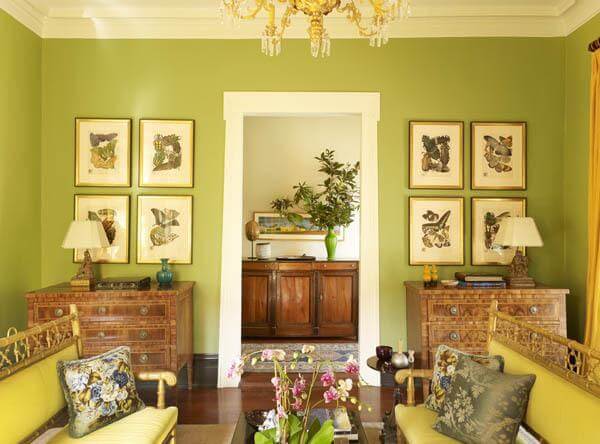

“Go everywhere and look at everything.”
This is a favorite quote by Albert Hadley about finding inspiration that Thomas has lived by ever since working at the prominent design firm, Parish-Hadley & Associates. Like his mentor, Thomas says that he goes to “small galleries, minor openings … always looking at new things, from contemporary decorative arts to interiors of all kinds.”

Positive Inflections of Color
Adding color does require risk taking, but if an interior personalized with color is the goal, it is important to seek the help of a capable designer. If you jump into a project with the idea that innumerable choices and free advice on the Internet put you in the designer’s seat, “you will probably end up with a beige house,” Thomas says. Find a discerning advisor who can rise above the neutral safety net to create your tasteful yet distinctive living space.
“Don’t be afraid to repaint a room.”
This is another guiding quote he recalls from Albert Hadley. Thomas uses paint to instantly make a room fresh and new; he goes to an eggshell surface for rooms such as the kitchen where washing the wall on occasion will be necessary. He uses a matte finish for rooms that may require fixing and patching over time, such as a child’s room. He is also a fan of decorative paint for adding color along with texture to walls and furnishings, but he points out that decorative painting should be approached like the dessert course. Just as you should not go overboard on dessert, do not overuse this technique in a room.
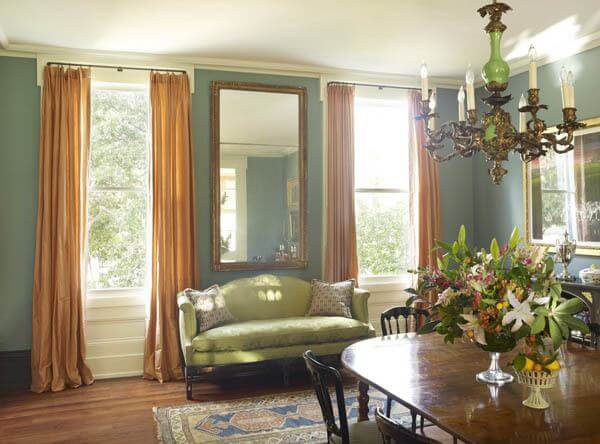

In with the old (but never without the new!)
Thomas believes that even in this modern age, there is great value in decorating with antiques. He maintains that they add visual depth, texture and personality to every type of room. “There are other benefits: they are usually less expensive than comparable new furniture, and often, unlike their recent counterparts, they retain value.” (“Why Have Antiques?” by Thomas Jayne, from The 2012 Philadelphia Antiques Show.)
In a nutshell, the key components of Thomas’s creative process are sense of place and sense of personality. He always designs “in context,” creating a sense of the place and function of that space. A room should look like what it is used for: a house in the South, for example, should have elements of Southern charm. And sense of place is always balanced with a sense of the owner’s personality.
Two notable and recent projects at the Jayne Design Studio include the president’s home at Yale and an installation at the Rhode Island School of Design where he is consulting for a special exhibit of American art and Decorative art from the 18th and 19th centuries. Thomas is especially known for his ability to create tradition within a modern setting: “But, you must have ‘new’ with the ‘old,’ even in the most traditional room,” he explains. He achieves this by adding an element of the unexpected to make that room special. This element may be a surprising use of paint, color, a fabric or an object, but, as we have enjoyed visualizing through this tour of Julia Reed’s home, the final design will always be reflective of the client.
Photography by Pieter Estersohn.