

FACES of Nashville: Shani Jackson Dowell
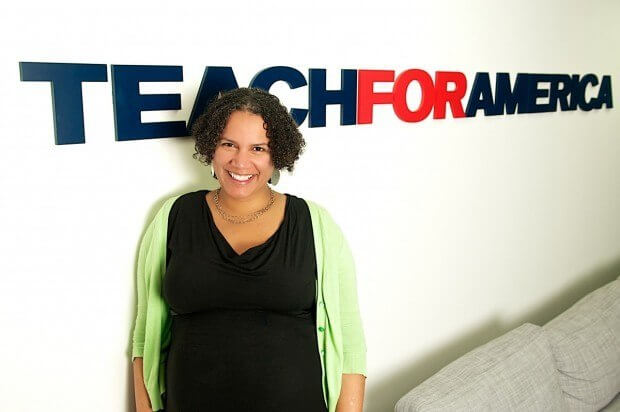
Meet Shani Jackson Dowell, the executive director of Teach For America/Nashville and a woman determined to change kids' experiences in the classroom.

Where did you grow up?
I am originally from Houston, TX. I grew up there, and then went to college in Washington, DC, before living in Boston, the Bay Area, then coming back to Houston to teach in my home community.What brought you to Nashville?
I started working in education through a national nonprofit called KIPP. KIPP launches high-performing, college-preparatory schools that predominantly serve students growing up in low-income communities. In 2005, I worked with KIPP helping school leaders get their schools started in the South. One of the school leaders was launching a KIPP school in Nashville. I fell in love with him and the city of Nashville. In the summer of 2008 we married and I moved to Nashville.Can you describe a mentor in your life?
I have the privilege to be surrounded by many mentors and amazing people, from my colleagues at Teach For America, to the parents, community members and leaders with whom I have the opportunity to work. Specifically I would love to shout out just a few of the incredible women I’ve known: Daphne Butler and Julie Frist (Teach For America’s regional board chairs), Elissa Kim, Alice Randall, and Shirene Douglas who who all at different times and in different ways inspire and push me.For any of our readers who aren’t familiar with Teach for America, can you give them a condensed overview of the organization?
Teach For America believes that every child should have access to an excellent education. In Nashville we work in partnership with district, school, and community leaders to make sure every child has a great school to attend. Because we believe deeply in the power of great teachers, principals and educational leaders, we work to recruit, train, support and develop some of our nation’s most promising college graduates who commit to teach in our nation’s highest need schools, working to have an immediate impact on the academic achievement of the students in their care. Meanwhile, they develop the skills, insights and convictions to become long-terms leaders in the pursuit of educational justice, whether as teachers, principals, district administrators, parent organizers, politicians, or active members of their communities.
As executive director of Teach for America/Nashville, what challenges do you face in your job?
I think our biggest challenge lies in getting past our city’s legacy of lowered expectations and a set of powerful misperceptions about students and families in our public schools. Today, when we see that fewer than 10% of the 55,000 low income students in Nashville will graduate from high school ready for college or career, we’re quick to place blame, to assume that the kids don’t try or that their families or teachers or educational leaders don’t care. We have to change this. For our city to ensure that every kid has access to a great school we must do two things: First, we have to believe it’s possible. Second, we have to recognize our urgent, individual responsibilities to make it a reality.As a previous math teacher, why do you think US students under perform so dramatically in math and science?
As I told my middle school students in Houston, “Math is life.” To be a critical thinker and productive citizen, you have to know both the principles of math and have confidence that when presented with a problem you can use what you know to figure out what you don‟t. As I teacher, I was saddened to see that many of my students had already deemed themselves “bad” at math. Many positioned their struggles as an almost “generational curse,” something that ran in their families. In my own childhood, I remember similar feelings. After performing poorly on a standardized science test, I was quick to conclude that math and science just weren‟t for me. As a country, we accept far too readily that, for many kids, math just isn‟t their thing. In our work here in Nashville, we have seen pretty dramatic math outcomes with some of our city’s highest-need students. In 2012, first year teacher Rich Richards led his North Nashville 5th graders to outperform Williamson County 5th graders in math. In 2012 Jake Ramsey led 76% of all 8th graders at KIPP Nashville to be proficient or advanced in Algebra. Results like these prove what possible when we begin to shift our mindsets and inspire students to do the same. Carolyn Dweck’s book, Mindsets, offers a powerful testament to the power of mindsets. I recommend it for any parent or educator.
Is there a glaring misconception that people have about the public schools in Nashville?
I think the biggest misperception is that the problems are insurmountable. As any committed teacher, principal, administrator or parent will tell you, we have a long way to go to ensure that every child in our city has access to an excellent education. But we also have a growing body of evidence that suggests with committed, courageous leadership at every level of the system, drastically different outcomes are possible. This will not be easy or quick, but it is squarely within reach.What is the best advice you can give someone considering a position with Teach for America?
Working towards educational opportunity for all kids is a wonderful mission. This is work you tackle because you believe so deeply in what is possible for our country and all of the amazing individuals within it. You join in this movement because of a belief in mission. When you join Teach For America, you are joining a diverse, national organization of some of our nation‟s most promising talent to work relentlessly towards a vision of “one day” when every child in our nation has access to an excellent education. Your peers in this work will be recent college graduates and 5-year military veterans, people who were themselves taught by Teach For America corps members and exceptional campus leaders. They will be diverse in background and skills, united by a common vision. For your commitment and work, you are developed as an educator and a leader, are able to impact lives and become part of a lifelong commitment and network of folks working to insure educational opportunity for all students. You get to see the growth of human potential– in yourself, your students, and your colleagues–in incredible ways.