Meet the First Recipient of a New Indie Memphis Accolade
Jamey Hatley credits the attacks of 9/11 with being the turning point in her life that led her to finally pursue a writing career. Find out more about this award-winning writer, get her best advice and more.
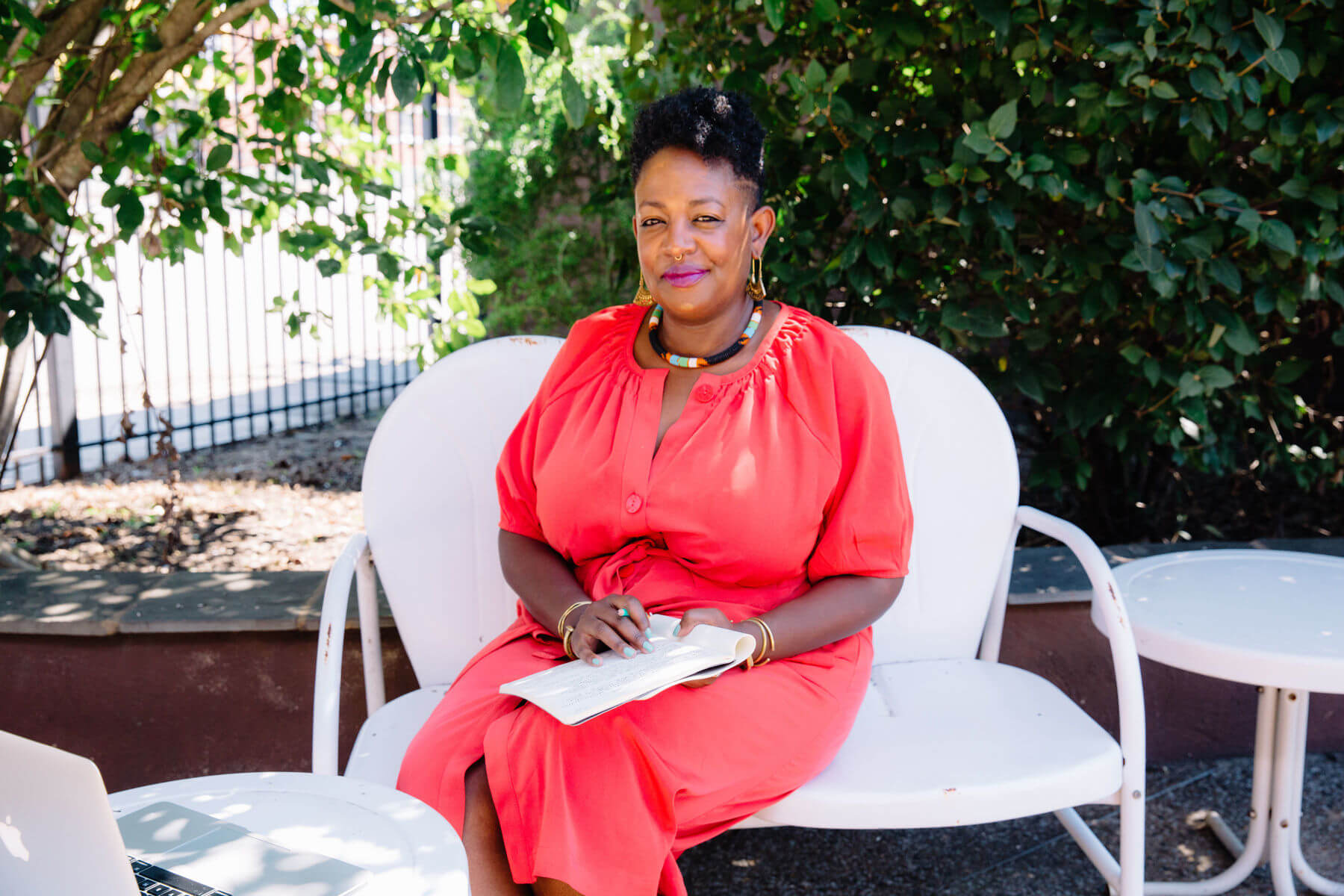
While working as a librarian, Jamey Hatley would anticipate the arrival of new books from seasoned and budding authors; but her anticipation was oftentimes met with a wave of frustration. Intrinsically, she knew that she too was supposed to be penning short stories and novels. Jamey credits the unfortunate events of 9/11 for forcing her to rethink her life and her writing ambitions. Deciding not to lead a life filled with fear, she began to pursue her long-standing interest in writing. She enrolled in workshops that catered to writers of color, including the Callaloo Creative Writing Workshop, a premier literary organization. She then took it one step further and pursued a Masters of Fine Arts from Louisiana State University. After graduating, Jamey remained in Louisiana for nearly a decade working in the literary circuit. She eventually ‘wrote her way back to Memphis’ in 2014, and that’s when the accolades started rolling in. In 2016 she was chosen as Prose Fellow for the National Endowment for the Arts and was a Rona Jaffe Foundation Award winner. Most recently, the award-winning writer was announced as the recipient of the inaugural Indie Memphis Black Filmmaker Fellowship, handpicked by renowned film director, Barry Jenkins. Through the fellowship, funds are allocated to assist Jamey in the development of her upcoming screenplay, The Eureka Hotel. The inspiration behind the play is a now-demolished house in Memphis that was once situated near the National Civil Rights Museum. Jamey spoke candidly with us about lessons she’s learned since becoming a full-time writer and what she loves most about the city that inspires most of her literary work. Welcome our newest FACE of Memphis, Jamey Hatley.PinJamey Hatley is an award-winning writer. She’s also our newest FACE of Memphis.
When do you fall in love with writing?
I’m a nervous, anxious writer. I have some friends who write, and that’s their safe space, but when I’m writing I’m usually writing nervously. So much so, that when I’m in my zone people will ask me if I’m okay. Writing is very satisfying and I enjoy it, but in love with it? I’m not sure. I just don’t want to romanticize it because it’s really hard work. I’m a perfectionist and have really high goals for myself as a writer so that plays a lot into my anxiety while writing.
We are grateful to all our sponsors:
When did you decide to pursue writing as a professional career?
I had a lot of jobs before deciding to pursue writing full-time. I worked in the music industry and nonprofits, but I couldn’t stop writing the stories. I was working as a librarian and realized that I had to do something else with my career because I wasn’t even a full librarian. And although I was good at it, I knew that I was supposed to be doing something else.
Everything changed when the 9/11 attacks happened. I was in Memphis at the time and had an online writing community. When 9/11 happened, I realized that the world is really fragile and you may not have the time you think you have. It snapped me out of this kind of youthful way of thinking. So, knowing that it could all be taken away from me and knowing that I had some serious ambitions, I knew that I was going to have to begin actually writing some things.
Although I’d been writing a little — I had a raggedy novel I was working on — I hadn’t fully pursued it until after 9/11.
Pin“I just don’t want to romanticize it,” Jamey says of being a writer, “because it’s really hard work.”
You’ve written dozens of stories and received some pretty amazing accolades, including Prose Fellow for the National Endowment for the Arts and recipient of the Rona Jaffe Foundation Award, but when did you become comfortable calling yourself a writer?
When I began going to these writing workshops and saw my work alongside these writers who had been doing it for a long time, I stopped being so hard on myself and realized, ‘oh my stuff is actually good.’ When I got in community with other writers, I began considering myself a writer. And that’s why I think it’s important to build community.
I studied with so many other amazing writers that have helped and coached me along the way. That gave me the confidence and the community to embrace myself as a writer.
How would you describe yourself as a writer, or your writing style?
A lot of understanding of who I am as a writer comes after a piece is made. I think you have to do a lot of work to understand what kind of writer you are. I’m always learning the things that are important to me. Black people are important to me. Memphis is important to me. I also recently realized I’m obsessed with ruins and things that hold a lot of history. There are usually only some questions that I can answer only through writing. As a writer I’m interrogating myself, my city, and the world that I live in, and as a storyteller, the story that we take for granted.
PinOne of Jamey’s three things she can’t live without? “Excellent writing instruments.”
Most recently, you were announced as the recipient of the inaugural Indie Memphis Black Filmmaker Fellowship in Screenwriting, where you secured a grant to help you develop your screenplay, The Eureka Hotel. Why did you decide to shift to screenwriting?
My writing life is not according to plan. It still startles me when people consider me a screenwriter because I’m a literary artist. I have never taken a single screenwriting class even while I was getting my MFA at Louisiana State University because I couldn’t imagine myself doing it. I knew that you give your work to a director and they could do what they wanted with it. And I didn’t like the idea of that.
You’ve said that you “wrote your way home to Memphis.” How does the city inspire you and your writing?
Well I’m from here … I’m of here, and it’s my city. There are stories of people here that haven’t been told. There is so much rich history. I think that there has been so much shame surrounding Dr. King’s assassination, but I think without truth and exposing all of those stories that there can’t be justice. And Memphis still hasn’t seen justice. I think it’s my mission to tell those stories.
What are some of your favorite places to go in Memphis?
The Stax Museum and The Civil Rights Museum are my top go-to places. It’s important to not just go to the museums but see the neighborhoods. I’m also a foodie. I love The Four Way grill and Miss Girlee’s. And if I want to be in a beautiful room, I love Restaurant Iris. I also love The Second Line. Those restaurants have become like family to me.
I also do most of my writing in the window of Otherlands Coffee Bar.
PinA passionate reader and bibliophile, Jamey knew she was destined to be a writer herself.
What’s the best piece of advice you’ve received?
My mentor, Memphis native Arthur Flowers, always tells the story of telling a friend he wanted to be the greatest novelist who ever lived. She said, “No, Art, that’s not what you want. You want to sing your song the best you can sing it. That way you can appreciate other folks singing theirs.”
I think that’s why I can truly celebrate other artists. There is always enough room. My shortened version is, “Keep your eyes on your own paper.” You can’t measure your success with somebody else’s ruler.
We are grateful to all our sponsors:
Aside from faith, family and friends, what are three things you can’t live without?
I cannot live without excellent writing instruments, perfume, and beautiful art.
Thank you, Jamey. Learn more about Jamey’s work at jameyhatley.com. And thanks to the talented Elizabeth Looney for the fantastic photos of Jamey.
**********
Want insider tips from financial experts? Check out our expert series with Reliant Investment Management. In our latest installment, they share the six steps that will put you firmly on the path to financial security. Click HERE!Pin
Our unofficial motto at StyleBlueprint is "Be kind. Do good." We encourage this to be the basis for all comments on our articles. Provide feedback that adds to the story. Some controversy or disagreements are part of any good dialogue between friends, but anything that tears down or belittles others is subject to disapproval or removal. Thank you for being a member of the StyleBlueprint community! View our Community Guidelines.