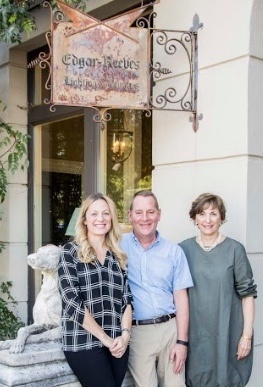
“Lighting has the ability to capture your style while also providing a purpose,” says Maggie Bailey of Atlanta’s Edgar-Reeves Lighting. Through her store, which she co-owns with her husband Matt, Maggie makes the seemingly stressful process of selecting lighting both personal and approachable. Yes, shopping for lamps and lampshades can be daunting — there is no limit to the combination of shapes, heights, finishes and styles, and narrowing down the selection to just one perfect style for you can be a challenge for sure, especially if you’re tackling a project without a designer. That’s why Maggie and the staff of lighting experts at Edgar-Reeves are eagerly awaiting your arrival. At their Buckhead showroom, you can receive guidance in selecting the right shade for an existing lamp, placing the shade at correct height, helping with hardware, or adding a smidge of detail with a finial — all while taking into account your personal style, purpose and budget. As Maggie says, “It is always an ideal time to improve or update your current lighting.”
PinWelcome to Edgar-Reeves! Located near ADAC, the Edgar-Reeves lighting showroom and shop is filled with all of your lamp and shade needs.
Today we’re speaking with Maggie about the crucial elements of lamp shades, what to do when you fall in love with a shadeless antique lamp, and what makes a good marriage between a lamp and its shade.
How Lamps Complete a Home
Does choosing a lamp start with scale? Intended use? Color? Help! Where do we begin?
Great question … it’s up to you! You can build a room around a lamp, or you can finish a room with a lamp; it simply depends on where you are in the decorating process. If you have a special lamp and you know you want to use it, find a room or space where it fits comfortably. Then, you can develop the room based upon the lamp’s color, shape or style. On the other hand, if you need a lamp in a room that is almost finished, look for one that has the right scale, and then make sure it will play well with the other colors and objects already in the room.
PinIn addition to lamps and shades, Edgar-Reeves has a selection of hanging shades as light fixtures as well.PinDid you know that you can adjust the height of a lampshade simply by adjusting the height of the harp? Learn other tricks of the trade from Maggie during your visit to Edgar-Reeves.
Can you give us an overview of the elements of a lamp shade that we need to understand?
The lamp shade is a work of art and has more detail than most realize. The frame is the “skeleton” of the shade. This creates the foundation for the desired size and shape. The outer fabric is placed over the frame and is what is seen as the color or pattern of the shade. The lining is placed on the inside to cover the “ribs” of the frame while also protecting the outer fabric from the heat of the light bulbs. There are two main types of shades: soft back vs. hard back. Soft back shades are mostly used for pleated shades while hard backs are used for stretch shades (like a drum). The pleats can vary in style from box pleats to knife pleats to gathered pleats, and then even custom pleat design. The top and bottom of the shade can have different size trims (narrow or wide) or no trim at all. This is called a rolled edge. The metal hardware, usually found at the top of the shade, is called a spider, and it is what fits on the harp on the lamp. Lampshades come in all different shapes from empire to drum to modified drum to square, rectangle, oval and many shapes in between. In addition, we can custom make almost any shape and size to meet your lighting needs.
PinA lamp can be completely transformed with a shade. This colorful fabric by Collier Rose Ink makes a bold, playful statement.PinThe same lamp is then transformed with an elegant box pleat shade, Maggie’s personal go-to.
There’s an art to choosing the perfect shade. What makes the perfect match for a base?
You want the shade to “marry” the lamp and allow the two to comfortably live together. You definitely want to take into consideration the size of the shade. If a shade is too big, it will overpower the lamp. If it’s too small, it will look like a top hat on the lamp. Look at the shape of the [lamp] base. Is it round, square or rectangle? You can often use the shape of the base as a guide to choosing the shape of the lampshade. What’s the style of the lamp? Is it traditional, transitional or contemporary? There are shapes that lend themselves to the different styles. Do you want a formal or casual shade? Fabric can help determine such. And lastly, do you want color, or do you want a neutral shade?
What is the trick for pairing floor lamps, table lamps and even task lamps to make a room look complete and intentional? How many lamps should we have in a living space?
You want all the lighting to be able to live with each other. Every lamp and shade doesn’t have to be the same style or color, but you want them to fit comfortably together. The number of lamps completely depends on the room size, preference and intended purpose. Let your use of the room guide you. If you are intending to have fancy dinner or cocktail parties in the room, lean towards something dressier like a glass lamp with silk shade. If you want a less formal setting, go for a more casual style, like a pottery lamp with linen shade.
PinExpert tip: when removing a new shade’s protective plastic wrapping, use scissors and carefully cut around the inside. That way, there’s no chance of harming your shade’s brand new pleats!PinEdgar-Reeves has floor to ceiling shades in different shapes, sizes, and styles, plus all the trimmings too.PinTwo shades of similar shapes, but different styles sit side-by-side.
How often should shades (or lamps) be replaced?
Our shades have a long life and can still look fresh after 10 years. We often tell clients that buying a lampshade is a long-term investment. As far as lamps, they can last generations. Over time, the wiring may need to be replaced, and if you want a different look, you can change the base or shade, which can change the whole look of the lamp.
What are today’s lamp trends?
We have seen an increase of re-creating lamps or changing an existing lamp to fit your decor. For example, say you have antique blue and white vases with brown bases, and you want to update them to make them more transitional. Place a Lucite base on them and voila … new lamps! Glass lamps can lend themselves to be paired with color and patterned shades, which are very popular right now and fit-in almost anywhere.
While wandering antique stores, chances are we’ve all had that moment of lamp love at first sight. However, these lamps sometimes come with an ill-fitting shade or worse, no shade at all. If we do fall in love with a shadeless lamp, what’s the best way to find the right shade to complete it?
Yes, we have all had this experience, and this type of situation is where we can help. First off, buy the loved lamp! Then bring in your lamp, and we can find a shade that both complements the lamp and completes your intended use. If needed, we can rewire or change the harp so the shade sits at the right height.
PinFinials can add a little bit of detail to any lamp. Do you spot a favorite finial in the group?PinA box of lamp tools and pieces is never far away at Edgar-Reeves.
Even though it’s hard to choose favorites, what is your go-to lamp shade shape, texture and color?
My personal go-to lamp shade is the empire box pleat in silk or linen; it is elegant and timeless and, depending on the fabric, can be used for casual or dressy. As far as color, I love our bone silk and oat linen, or if I was creating a custom shade, I love a great blue patterned fabric.
Atlantans, look no further than Edgar Reeves for all of your lamp needs. They are ready to help you make old lamps new again, assist in shade selection, and even give you a few design tips along the way. Simply bring your lamp into the shop, and let Maggie be your guide.
PinCome see the experts at Edgar-Reeves for all your lighting needs!Edgar-Reeves is located near the Atlanta Decorative Arts Center (ADAC) at The Galleries of Peachtree Hills, 425 Peachtree Hills Ave., No. 16, Atlanta, GA 30305. Showroom hours are Monday through Friday, 9 a.m. to 5 p.m. Closed Saturday and Sunday. Find more information at edgar-reeves.com.This article is sponsored by Edgar-Reeves.
Nicole is a life-long Southerner and freelance journalist based in Atlanta who relishes sharing the stories of inspiring Southern businesses and residents. When she’s not weaving her next tale, you can find her stitching cheeky needlepoint canvases or perusing area antique shops.
Our unofficial motto at StyleBlueprint is "Be kind. Do good." We encourage this to be the basis for all comments on our articles. Provide feedback that adds to the story. Some controversy or disagreements are part of any good dialogue between friends, but anything that tears down or belittles others is subject to disapproval or removal. Thank you for being a member of the StyleBlueprint community! View our Community Guidelines.