Hidden History of Vulcan, the Magic City’s Iconic Iron Man
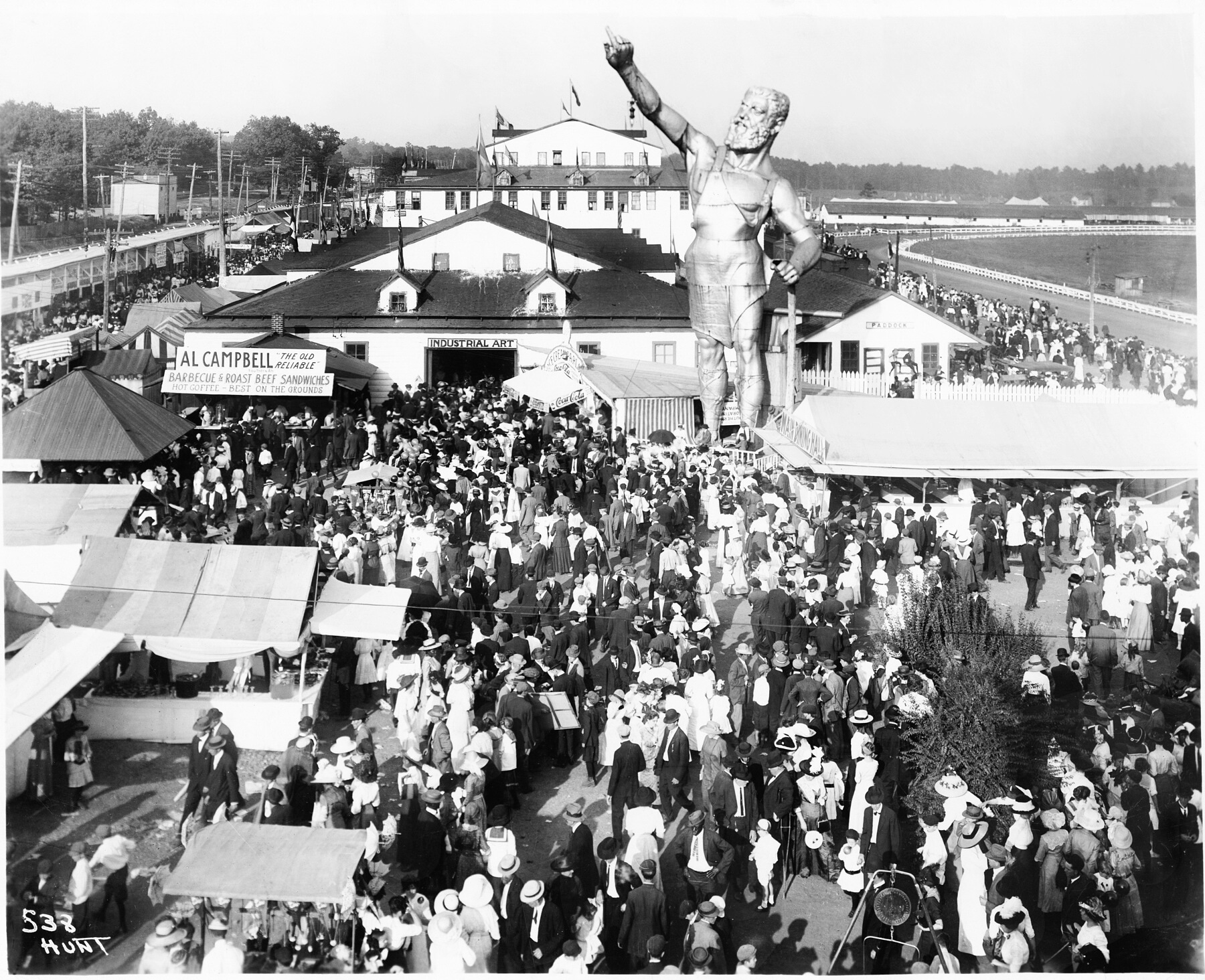
From his 1904 World's Fair debut to local advertising mascot to traffic awareness emblem, Vulcan has a rich history and his park and museum are building on that legacy. Image: Vulcan Park & Museum


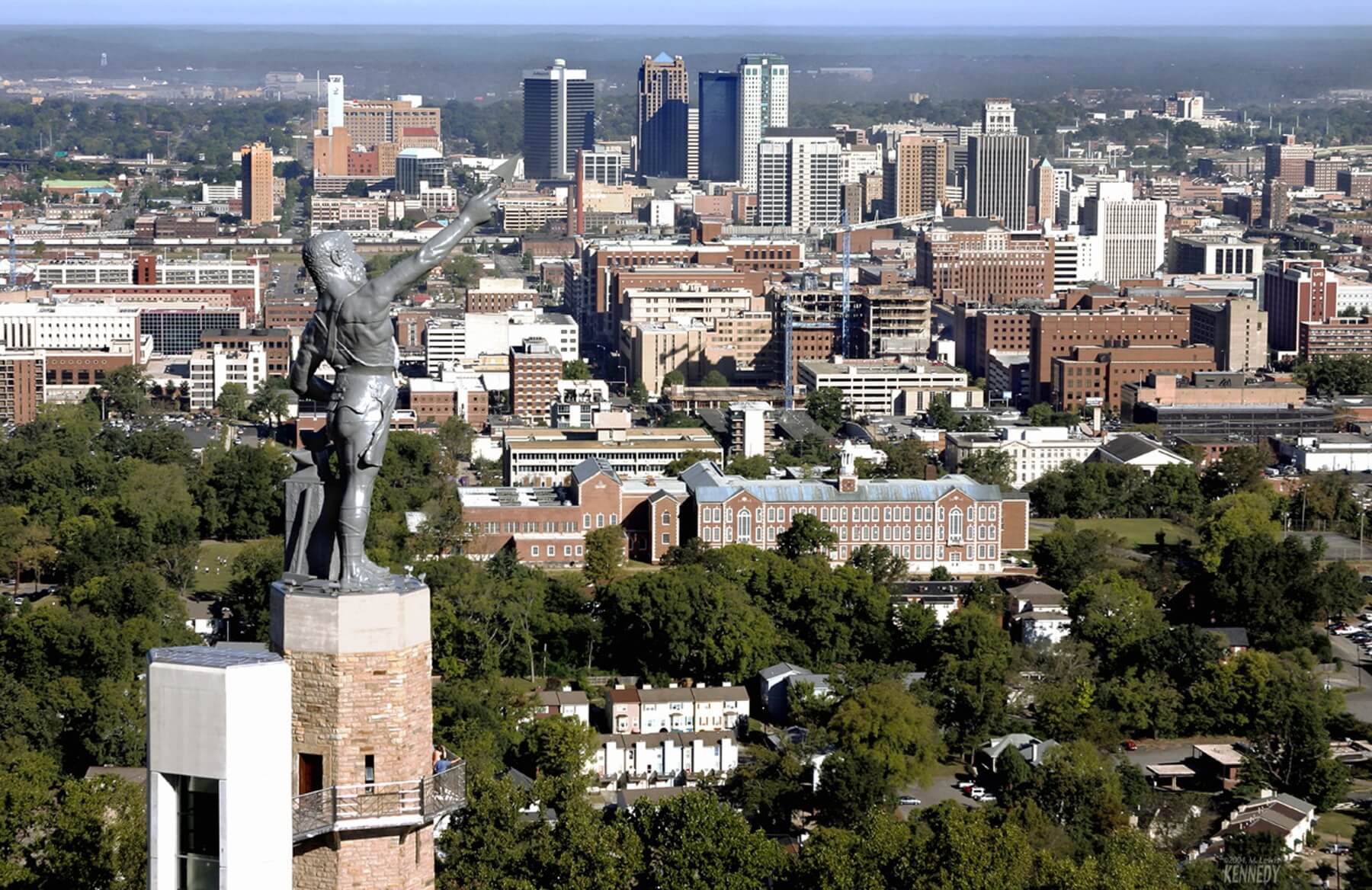
Vulcan displays the magic of the Magic City.
Birmingham was founded in 1871. Because the area where the city was planted contained coal, iron ore and limestone — the raw materials needed for making iron and steel — Birmingham boomed as an industrial city and by 1900 had been dubbed the “Magic City” due to its rapid growth. City leaders wanted to advertise Birmingham by entering an exhibit in the World’s Fair in St. Louis. The Birmingham Commercial Club, a precursor of the Birmingham Regional Chamber of Commerce, decided a statue of Vulcan should be the symbol of our Magic City. In Roman mythology, Vulcan was the god of the forge, a shop with a furnace where metal is heated and hammered into useful items. But the statue wasn’t about symbolism alone. The creation of Vulcan, which stands 56 feet tall from toe to spear point, would mean creating the largest cast iron statue in the world and the largest metal statue ever made in the United States.
Vulcan needs a home.
After the World’s Fair, both St. Louis and San Francisco made offers to purchase Vulcan, Darlene says. “San Francisco wanted to put him in the Bay to be a bookend for the Statue of Liberty,” she explains. “It really raises his stature to think of him dating the Statue of Liberty,” she adds with a laugh. But in 1905 Vulcan was taken apart and brought back to Birmingham by train. City leaders couldn’t decide what to do with him. There was talk of placing him in Capitol Park (now known as Linn Park) but the ladies of the neighborhood objected due to Vulcan’s bare backside.


Vulcan, the god of traffic safety?
Many Birmingham natives and longtime residents can recall the days when Vulcan held not a spear but a cone-shaped lighted beacon thanks to a group of citizens who thought Vulcan should be used to remind Birminghamians to drive safely. Vulcan’s signal glowed green on days when no one was killed in an automobile accident and red on the days when there was a fatality.
Birmingham citizens save Vulcan.
Over time, the concrete that was poured inside Vulcan in the 1930s to serve as an anchor began to expand and contract causing cracks in the statue. Furthermore, since Vulcan did not have a top to his head, rain poured into the statue, too. In 1999, Vulcan had to be removed from his pedestal atop Red Mountain. “There was not a plan for what to do with him at first,” Darlene says. “He just had to come down because he was about to crumble and fall.” The Vulcan Park Foundation was formed to raise money for Vulcan’s restoration. “The community really stepped up to the plate,” Darlene says. “The community rallied to save him. We were getting checks from little old ladies, and there were these school programs where they would give quarters and nickels to help save Vulcan.” Though the City of Birmingham and the federal government contributed to the fundraising efforts, most of the $16 million that was raised to save Vulcan came from residents and local corporations. “To me that just shows how near and dear he is to everybody’s heart,” Darlene says. In 2003, Vulcan was placed on his pedestal once again and the following year Vulcan Park reopened, too.

Preserving the past and forging the future.
Museum specialist Lindsay Elliott wants Birmingham residents to know that a visit to Vulcan is not just a chance to get a great view of the Birmingham skyline but an opportunity to learn more about the city’s history, too. “Not everybody knows we have a museum up here, and I think it’s exciting because we really cover Birmingham’s history,” Lindsay says. “So if anybody is new to town or still just doesn’t know a lot of Birmingham’s history, we are such a good place for helping them understand the broad view. We have so many other museums that cover sections of Birmingham’s history, but we’re really the one that does the comprehensive overview.” The Vulcan Park & Museum recently announced a partnership with the Birmingham History Center, which has collected and preserved historical artifacts and memorabilia for over a decade. The Birmingham History Center has collected over 13,000 objects, including a knight’s armour that once stood in Blach’s department store, a J.W. Sloss money box, two carriages, scrapbooks, photographs, letters and a host of other documents. Many of these artifacts will soon be on display at the Vulcan Museum. “We’re excited that all of these objects that are in storage will hopefully be able to come to light and become more available for research and display in our museum,” Lindsay says.


**********
Want the best of everything local? Subscribe to StyleBlueprint!

Javacia Harris Bowser
Javacia Harris Bowser is a Birmingham-based freelance writer and the founder of See Jane Write, an online community and coaching service for women who write. With over 20 years of journalism experience, Javacia has received awards from the National Federation of Press Women, Alabama Media Professionals, Alabama Press Association, and the Alabama State Council on the Arts. When she’s not writing, she’s usually practicing Pilates, getting her 10K steps a day, or watching crime shows. Follow Javacia on Instagram @seejavaciawrite.