The centuries-old tradition of the debutante ball continues to thrive in the South. Still steeped in tradition, what was once a way to announce that a girl was fit for marriage, these events now provide families and friends a chance to celebrate, dress to the nines and give back to the community.
Once considered to be a family’s announcement of their daughter’s marriageability, debutante balls continue to flourish today for different purposes. Still steeped in tradition, these balls are now more about fostering community between young women (and men!), devoting time and resources to charity, and celebrating the maturation of teens into young adults. Although these balls occur all over the United States and throughout the world, there is something so very Southern about them. Their original purpose is now gravely outdated, but today’s debutante balls are a chance for a group of women and their families and friends — however exclusive that group may be — to celebrate together, make lasting friendships and give back along the way.
Editor’s Note: Of the dozen or so debutantes we asked to speak to for this article, we heard many versions of the same response: “It was a special experience that I would like to keep in my memory,” “My parents told me that many of the traditions are secret, so I can’t talk to you,” or “I can’t publicly post the photos.” Because of this recurring theme, names have been changed and removed from the photo credits to protect privacy.PinBeaming debutantes proceed for guests under a chicly decorated tent at one Virginia ball. Image: Submitted
We are grateful to all our sponsors:
Then vs. Now
The word debutante is derived from the French word debut, or “a first performance or showing.” Similar types of celebrations have been around since the 1600s, making their way to the United States in the early 1800s and Europe in the late 19th and early 20th centuries. The Christmas Cotillion in Savannah, Georgia, is said to be the oldest debutante ball in the United States, beginning in 1817. In those days, even dating was considered scandalous, and young girls of a certain social status would be “courted” by eligible young bachelors. The process would take many (highly chaperoned) encounters over multiple social “seasons” and often in different major cities. However, no young woman was considered eligible for marriage until she was formally presented to society. The debutante ball emerged as a family’s way of announcing that their daughter was of marriageable age and good breeding.
PinSome classic debutante styles from the 1950s | Image: Getty Images
Emily Post published a book on etiquette in 1922 that solidified the debutante ball as the glamorous rite of passage it is today. In it, she describes these balls as the “cornerstone of society.” From the roaring ’20s on, debutante balls were taken more seriously across the country. We spoke to Nancy, a North Carolinian who made her debut in 1978, whose mother debuted in 1945 and whose daughter debuted in 2010. This multi-generational perspective illuminated the familial importance of the deb ball. “I remember, in high school, my mother telling me that I needed to mind my manners because someone was always watching,” Nancy explains. “She said, ‘If you want to be a debutante one day, you’d better be ladylike and mind your manners.'”
PinNancy, who debuted in 1978, mentioned that the presentation during the North Carolina State Ball in Raleigh used to take this wheel formation, as shown in this photo from 1938, though the tradition has changed today. Image: ncpedia.org
We are grateful to all our sponsors:
While Queen Elizabeth II discontinued her support of the balls in England back in 1958 (here is a great article on why), they still occur in the United States. In fact, today, girls across the country typically “deb” during the second half of their college years. Friends — both guys and girls — travel far and wide to support their friends and attend the parties. In the South, it’s not uncommon to make your debut in multiple cities or through different balls, depending on your family lineage. “Some girls in my sorority had been to six or eight different debutante balls all over the country by senior year,” says Catherine, a recent debutante from Virginia. “And some were debutantes in two or three states themselves.”
Let’s explore how the process works.
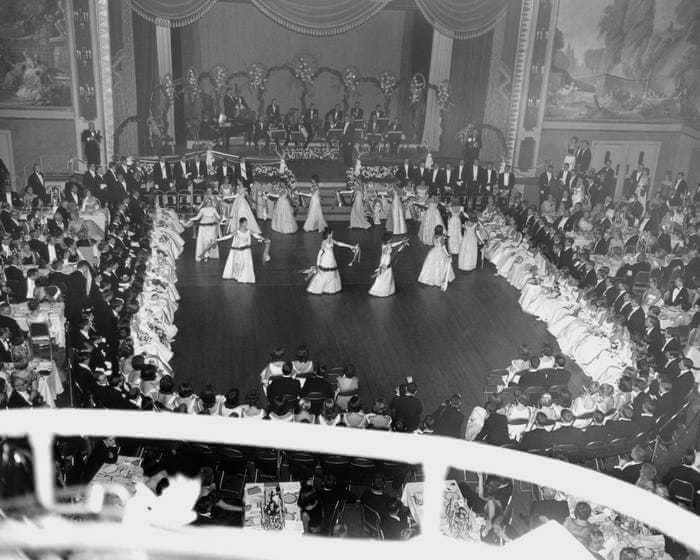
PinChoreographed dances are a major tradition at these balls, this one from 1963 at the Waldorf-Astoria in New York City. Image: Business Insider
How One Becomes a Debutante
A debutante is typically chosen because one or both of her parents belong to the clubs or society that “host” the balls. Many of these clubs are centuries old, and families have often had several generations of women debut under the club’s name, such as a grandmother, her daughters, and their nieces and daughters. While this is still the standard practice of debuting in the South, some balls are open to anyone interested in debuting. One thing they almost all have in common? They’re unpublicized and kept quietly away from the public eye. You will rarely find a website for a local debutante ball like you would for a wedding or other social affair … this is not an event that needs any marketing.
“One city in North Carolina has a ball that’s sponsored by a men’s club, and another one in a neighboring city is sponsored by a women’s club,” Nancy tells us, emphasizing that it’s not always groups of men who are the debutante gatekeepers. “If a young woman really wants to make her debut through one of these groups, but her parents are not members, she might approach it with the finesse of trying to be sponsored for country club membership — befriend a member of the sponsoring club and subtly start the conversation,” Nancy says. It’s about being socially savvy. She says that most groups she’s familiar with will often welcome guest debutantes whose parents don’t have connections to the group.
PinAn enchanting image of a debutante and her father from a North Carolina ball | Image: Submitted
Once chosen as a debutante, there is often a hierarchy within the group. Some of the longest-running and most established balls — such as those in Texas, Missouri, and Louisiana — will crown one queen who’s chosen based on her family’s history in the city, their standing in the community and whether or not her mother and/or sister was also a queen. In the majority of balls in the South, however, the debutantes are all equal. “The number of debs in our particular group has remained steady throughout the 15 years I’ve been involved,” Nancy tells us. “During the recession, the number went down a bit, because it was an expense that many families chose to cut out.”
We are grateful to all our sponsors:
Picking a Dress
A lot of time and money goes into the unique experience of a debutante ball. The capstone soirée is just the tip of the iceberg that is a multi-million-dollar-a-year industry in the United States. One source tells us that a Mardi Gras season debutante in New Orleans can spend up to $250,000 on the affair. While some balls require just a floor-length white gown and gloves, others costume the debutantes in elaborately adorned dresses and jeweled crowns that have been known to end up in museums. One report we read says San Antonio’s Order of the Alamo Queen’s dress costs $60,000, while another source in St. Louis threw out the number $15,000. Alternatively, we spoke to a former deb from Virginia who wore her older sister’s dress to her ball, and another from Nashville who wore the same dress she wore to her high school graduation (long and white), so clearly there is no one-price-fits-all solution when it comes to the dress.
Nancy reflects on her dress: “There was a woman in my hometown who made these intricate deb dresses, and everyone went to her. She only made a few each season, so my mother got me in line ahead of time. It was hand-beaded and beautiful. I ended up pulling it out of the box years later, changing it a little and wearing it as my wedding dress.”
No two balls are the same, and while one deb’s gown might weigh 40 pounds with a 40-foot train, another might be simple and off-the-rack. As for the ball attendees, the affair is a fun excuse to get dressed up for a black-tie affair. The aesthetic is typically conservative and sophisticated.
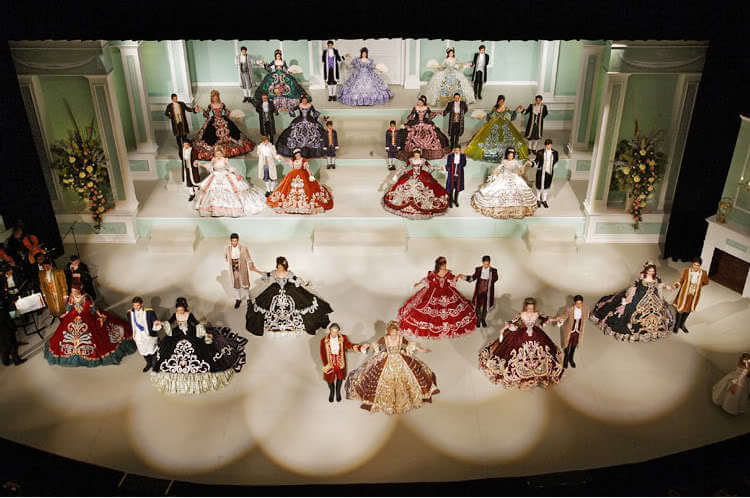
PinDebutantes and costumed guests dance at a New Orleans Carnival ball in the 1930s. Image: Public domainPinLaredo, TX, is home to an 80-year-old debutante ball that honors Martha Washington and the Spanish-American War. Little has changed from the first ball, and this event garners global attention for the elaborate 100-pound custom-made dresses and rigorous year-long debutante training. Image: traditioninaction.org
Debutantes Give Back
Today, almost every ball in the South has a charitable component. They’re also sponsored by different groups to which the debutantes’ parents belong. Nancy’s club has a strong focus on giving back to the arts through donations to a large North Carolina museum and the symphony. Additionally, most debutantes are required to fulfill a certain number of community service hours. “Some girls I know whose deb groups required a lot of community serviceeven started their own charities,” says Catherine, the aforementioned Virginia deb. For most groups, there is a hefty fee to be a debutante, and a portion of that goes to the chosen charity. Some groups charge the young women with selling tickets to the ball, and those proceeds are donated.
Party Planning
After the deb is “presented” by her father, escorted by her marshall and bends for her final bow, it’s time to party. And we mean party. The balls are typically planned in the summer and take place in fall and winter when the young men and women are home for the holidays. The parties range in size, but they’re, for the most part, expensive, formal, and rival the production and planning of most weddings — complete with invitations, programs, seating arrangements, menus, open bars, flowers, hair and makeup, musical entertainment, and more.
PinOne debutante we spoke to remembers going to the ball as a little girl and dreaming of one day being a debutante. Image: Submitted
“When the drinking age changed to 21, there was a huge debate in the debutante community about alcohol’s role at these balls,” Nancy shares. Many balls shifted to junior/senior year of college so that most of the young men and women involved were 21. “My group imposed a two-year hiatus where no one debuted while the women caught up to the drinking age.”
Today, for some, it’s an opportunity for the newly drinking-age-legal to celebrate with parents and friends. And for others, there are still separate rooms with bars for imbibing.
A handful of luncheons and rehearsals lead up to the big night for the debutante, but those duties pale in comparison to the work of her parents, who plan the events. In most Southern states, in addition to the main ball, a number of auxiliary parties are thrown by smaller groups of friends and their families. These can be so over-the-top, you might even see celebrity entertainment. (We’re not kidding.)
PinThis New York City ball, while not in the South, exemplifies the formality and tradition of debuting. Onlookers snapping photos, lavish floral arrangements, and full coat and tails for the men are standard. Image: Shutterstock
The Final Curtsy
Once her name is called, and each debutante is ushered into her final, practiced curtsy, she typically hits the dance floor for a choreographed waltz with her escort(s) and with her father. Once they’ve completed the process of debbing, which can sometimes be rigorous and stressful, many women will mentor younger siblings or friends through their journey. They hand down their dresses, gloves, tips and fond memories.
When asked why she thinks these balls and the traditions are still going strong in the South, Catherine tells us, “Mainly because they’re fun. I think people in the South love an occasion to dress up and go to a party. I don’t necessarily see these events dwindling soon, but the impetus for them has changed. No one is ‘coming out’ to be pursued for marriage, but the actual events of the ball are more of a production every year.”
Nancy gives a more nostalgic response to the same question: “While a lot has changed, a lot remains the same. The white gown and gloves, the roses, the presentation, and the excitement and honor the women feel when they get to step into the spotlight amidst friends and family — I don’t see that going away anytime soon.”
**********
For the best of the South — straight to your inbox! — subscribe to our newsletter HERE!
Zoe is a StyleBlueprint freelance writer, Charlotte native, Washington & Lee graduate, and Nashville transplant since 2012. She teaches Pilates, helps manage recording artists, and likes to "research" Germantown's food scene.
Our unofficial motto at StyleBlueprint is "Be kind. Do good." We encourage this to be the basis for all comments on our articles. Provide feedback that adds to the story. Some controversy or disagreements are part of any good dialogue between friends, but anything that tears down or belittles others is subject to disapproval or removal. Thank you for being a member of the StyleBlueprint community! View our Community Guidelines.