Have You Been to the Secret Room at Gibson Garage?
Did you know there's a secret room in Nashville's Gibson Garage that houses nine of the brand's rarest, most sought-after guitars? We got a sneak peek at the space. Here's the inside scoop!
Tucked behind a stage and velvet curtain in Nashville’s Gibson Garage is a place unlike any other — a musician’s wonderland. At the end of a dimly lit hallway is a space fit for VIPs and musical sensations. A seemingly ordinary bookcase sits in a lounge often used for hosting musicians and artists. Behind these shelves, however, are nine of Gibson’s rarest, most sought-after guitars.
Referred to as the Vault, the space is not open to the public. In fact, simply knowing about its existence and asking a Gibson Garage team member about it does not guarantee access. “[Entry] is really on an invitation basis,” says Mark Agnesi, Director of Brand Experience at Gibson. “If there’s a kid … [who] reminds me of me when I was 12 years old, I [would] love to take that kid back and give them a chance to play an original ’59 Les Paul. [I would love to] let them experience what they’ve been reading about on the internet for the last couple of years.”
PinThe Vault inside the Gibson Garage includes a chandelier from the same era as the vintage 1950s electric guitars on display.
We are grateful to all our sponsors:
The space itself is nothing overtly eye-catching, with solid black walls and tan tile flooring. After all, the true stars of the show hang in glass cases on the walls. While these guitars are occasionally rotated out, two in particular never leave the Vault as they’re some of Gibson’s most prized possessions (if not the brand’s most prized possessions).
The first is a 1958 Korina Flying V that Gibson purchased in the 1990s. When Mark first started at Gibson in 2019, not only was the Flying V the first guitar he played in his new role, but it was one of the brand’s only vintage electric guitars in its possession at the time. “The thought of the Vault evolved around [this] guitar. [We thought,] ‘We have to show this off, and we really need to own our history,’” adds Mark. “When we were building the Garage, storytelling was a major part of the whole experience … In order to really tell the story right, we need to own our history. That is what started us down the path of putting the Vault collection together.”
Another showstopper — and one of Mark’s personal favorites — is the 1958 Korina Explorer. Otherwise known as “Big Ed,” this priceless instrument is known for its history and pedigree, serving as one of the rarest, most desirable guitars. “Big Ed is the guitar we’re probably the proudest of just because of how rare that guitar is and how important it is to Gibson’s history,” explains Mark. Only 19 ’58 Korina Explorers exist, and this one, in particular, was brought into the Gibson headquarters in a brown bag. Brand executives immediately knew they had something critical to the Gibson story on their hands. The guitar was first owned by blues guitarist “Big Ed” Thompson and was passed along to other notable musicians throughout the years, including Rick Vito of Fleetwood Mac.
“Big Ed is probably the most documented guitar,” says Mark. “We know the entire chain of ownership, and we have photos of that entire chain of ownership. It’s been on magazine covers and book covers, and it’s been in museums. Of the 19, that guitar is what it is, and that’s enough. It’s all about the story.”
PinFrom left to right: 1958 Korina Flying V, 1959 Les Paul Standard Sunburst, and 1958 Korina Explorer (aka “Big Ed”).
Mark says he recently found two new guitars for the Vault, and they’re extra special to him because they were instruments he sold while working at Norman’s Rare Guitars in Tarzana, CA. The first is a 1940 Rosewood SJ-200. With only about 100 in existence, this is a top-of-the-line, pre-war Gibson guitar. “If you were a big singing cowboy — a Gene Autry or one of those guys — that was the guitar you had,” says Mark of the instrument’s history.
Another new addition to the Vault is a 1924 Lloyd Loar L-5. While most Lloyd Loar guitars were in a “Cremona sunburst finish,” this specific guitar stands out among collectors and guitar fans because it’s the only one in existence that was finished in the Gibson factory in black. “This is one of one in factory black, and we didn’t have a Lloyd Loar L-5 in our collection,” adds Mark. “To have a one-of-a-kind is pretty cool.”
We are grateful to all our sponsors:
When Mark added these two guitars to the Vault, two others had to be removed, which leads to the question: what happens to guitars when they leave the Vault? “When guitars leave the Vault, they normally come to the other Vault, which is upstairs in HQ,” says Mark. “Here, we have a few hundred pieces stored, and that’s the real Vault. This is more of a showcase vault.”
PinFrom left to right: 1961 Les Paul SS Standard, 1961 Les Paul SG Custom, and 1957 Les Paul Standard Goldtop.
We are grateful to all our sponsors:
While guitars in the Vault sit in display cases, they’re still taken out often and used for their intended purpose: to make music. Recently, Richie Faulkner of Judas Priest and Mike McCready of Pearl Jam took the Flying V on stage to play a few songs during their respective performances. Musicians who play at the Garage itself will often go back into the Vault to pick a guitar to play on the store’s stage as well. “The great part about owning these things is letting them continue to make music,” Mark adds.
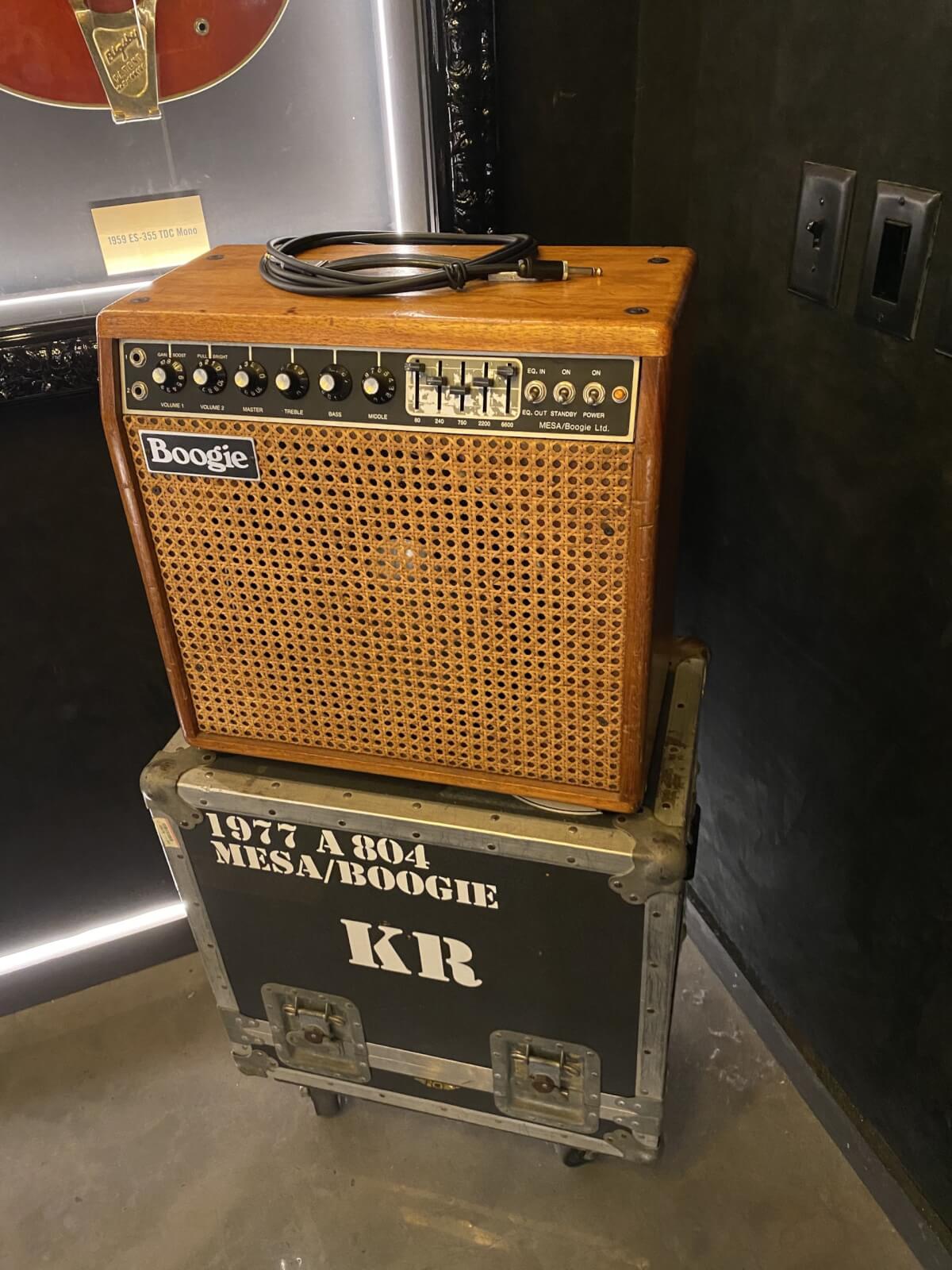
In addition to guitars, the Vault contains three amps that have played a critical role in Gibson’s history. One is a Mesa/Boogie Number Eight owned by Carlos Santana and used when he sat in with The Rolling Stones during a studio session. That amp inspired Keith Richards to want a Boogie amp as well, which now also resides in the Vault. The third amp is from former Gibson CEO Ted McCarty’s Kalamazoo, MI, office.
PinPictured here is the exact Mesa/Boogie amp Carlos Santana used during a recording session with The Rolling Stones.PinPictured here is the Mesa/Boogie amp used by Keith Richards of The Rolling Stones.
Whether you’re well-versed in the world of guitars or not, Gibson is a well-known brand and has played a critical role throughout music history. If you ever have an opportunity to step foot in the Vault, you’ll leave with a great appreciation for the brand and its contributions to music.
All photography by Brianna Goebel.
Brianna is StyleBlueprint’s Associate Editor and Sponsored Content Manager. She is an avid fan of iced coffee and spends her free time reading romance novels.
Our unofficial motto at StyleBlueprint is "Be kind. Do good." We encourage this to be the basis for all comments on our articles. Provide feedback that adds to the story. Some controversy or disagreements are part of any good dialogue between friends, but anything that tears down or belittles others is subject to disapproval or removal. Thank you for being a member of the StyleBlueprint community! View our Community Guidelines.