Yancy Villa-Calvo, Artist & Activist: FACES of Memphis
As a painter, educator and activist, Yancy Villa-Calvo finds commonalities between cultures and builds community through common ground. Meet today's FACE of Memphis!
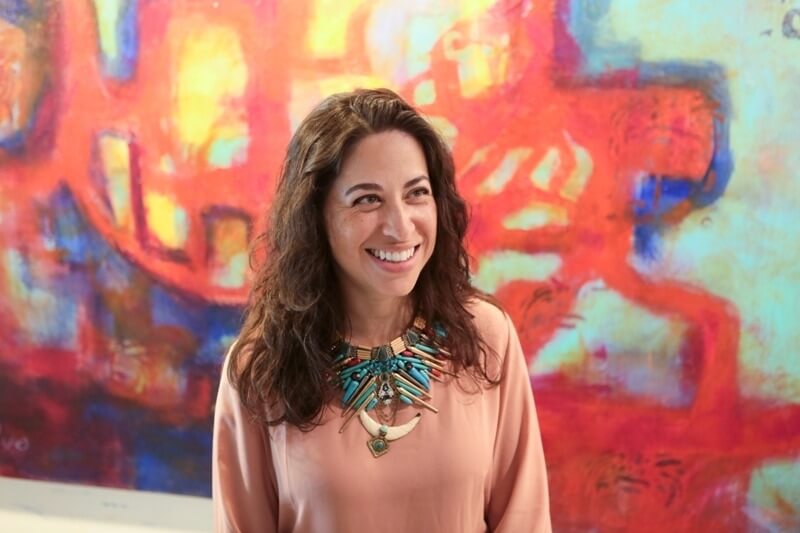
Yancy Villa-Calvo moved to Memphis from Mexico City as a teenager, enrolling at Christian Brothers University to study psychology and marketing. Even when she realized her true passion was art, she continued her studies, eventually receiving an MBA in addition to a Bachelor’s of Fine Art. She was pursuing a master’s in teaching while also serving as CBU’s director of academics for graduate and professional studies when a medical crisis forced her to balance her well-being with her constant drive to serve and engage. Fortunately, from that challenge came the opportunity to change course and dedicate herself to communicating through art.Also a mother of three and wife of Latino Memphis director Mauricio Calvo, Yancy is active in numerous organizations that advocate for social equity and civil rights. After a delightful introduction to her parents who were making an extended visit to Memphis, we sat down with Yancy at her home in Cordova to discuss her journey as an artist and her powerful new installation, Barrier Free.PinArtist and activist, Yancy Villa-Calvo
When did you discover you were an artist?
The last semester of my undergrad, I had to take either art or theater or music, and the only one that fit my schedule was acrylic [painting]. I didn’t even know what it meant, but it fit my schedule. I took it and I fell in love.
When did art become your career?
About five years ago, I had two episodes of paralysis. That’s when I definitely stopped everything, and I had to rethink what I wanted to do. I had a period of time that I couldn’t work, couldn’t drive, couldn’t do anything.
So that’s when my husband Mauricio said, “You’ve always wanted to do art, why don’t you do it now?” And I said, “No, no, no,” because the insurance was under me, and I had three kids. But then he said, “Look, God is going to provide. If you do something that you love every day, it’s going to make a difference and things are going to work out.”
We are grateful to all our sponsors:
How did you make the transition into an art career?
As an independent artist, I started figuring out what the art world meant. I remember the first show and exhibition. My husband — I had no idea — but he had in mind that he was going to put a red dot on one of the paintings and pay for it without me knowing, so in case nothing sold, at least I would see a red dot. But to my amazement, almost everything sold, and I was really happy, not really for the money, but for — oh my gosh, people actually like it!
PinYancy’s latest work is an installation entitled Barrier Free.
What inspired your latest installation, Barrier Free?
As an artist, you have to share what you are feeling; otherwise I don’t think it makes sense. I came up with this idea about reversing the idea of the U.S.-Mexican border wall. It was more about a tapestry of diversity, and showing how strong and beautiful diversity is. So that’s how it started, by saying, “OK, my message is not going to be negative.” It’s more about “Look at what exists right now. If you want this to continue, then we have to do something about it.”
That’s the message of Barrier Free, but it has three elements. One is the tapestry — I wanted to include all the diversity that exists. We hosted photography sessions with my artist, Andrea Morales. We got amazing families and individuals, all kinds.
RELATED: Local Art Experts Share Key Pointers for Starting (or Building) an Art Collection
The next element is silhouettes of families, made out of steel, but the last layer is a mirror, so that when the viewer is in front of it, they can see their own reflection. The silhouettes represent a call to action — that this could be you. It doesn’t matter what part in this society or what role you have, it will affect you eventually.
The third element is wish bands. In Mexico, when you have a desire or a hope, you write it down on a ribbon, and then you go to church and pray for it, and then you tie it to a statue of one of the saints. So I thought about the same thing, but doing it on an actual fence. And it has been heartbreaking, to see all the messages that people have.
PinAs an activist, Yancy uses her art to show the strength and beauty of diversity.
Is there a particular story that has really stuck with you?
One was a person who mentioned that her mother was escaping the war in Cambodia. Her two sons and husband died, but she got to the Thailand border, and after that she was able to come to the U.S. And now, obviously, they are very grateful because they have an opportunity to live. It’s so interesting because many of the quotes talk about their mother or their grandmother.
RELATED: Claudia Towell of Latino Memphis: FACES of Memphis
Do you think women have a special call during times like this?
Yes, definitely. I can talk about my experience. Normally I’m not very political. I say, “OK, let’s talk about positive things; let’s talk about unity.” But at this time, I think we have to say exactly what we feel, exactly how it is and how it’s affecting us. We can show our power and our strength by speaking out and not be waiting for something even worse to happen.
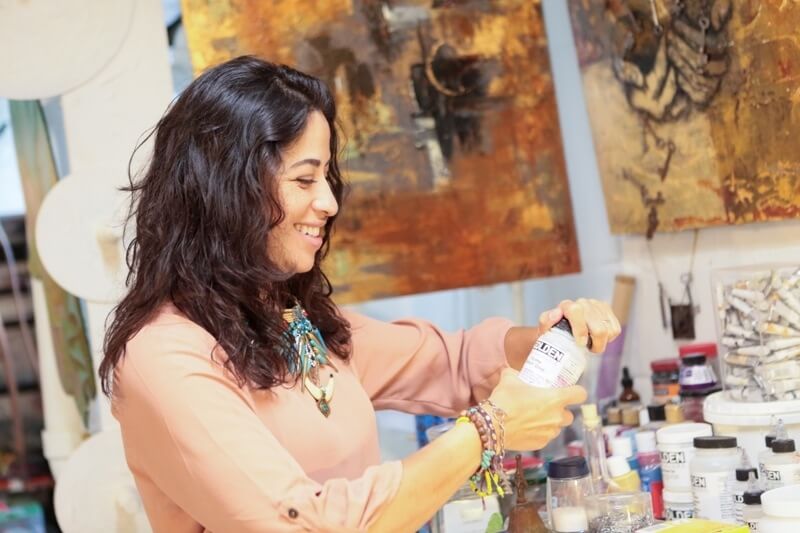
PinYancy smiles in her happy place, her studio.
How are your children involved in your art?
My kids have always helped me. From the actual painting, like helping me buy the supplies or with ideas and everything. But in the last art installation, my oldest daughter was really upset with us, because of the active role that we’re taking in the community.
For the longest time she didn’t say anything, but one day she burst into tears. She said, “Why are you doing all this? What if Immigration comes and gets you?” She was so scared, and we said, “Baby, you know what? It’s our duty.” Because we are permanent residents, we have this gift that not a lot of people have, so we have a duty. We have been given so much, so we have to give this much in return.
Whatever your role is, the kids are watching. Even if you think they’re on the sidelines, they’re watching.
We are grateful to all our sponsors:
What has your perspective been on the changes that have occurred in Memphis since your arrival in 1995, especially as a member of the arts community?
It has really been a 180-degree change. There’s so much investment, and I think the city is playing a really nice role. For instance, what’s coming with Memphis 3.0 is wonderful — they’re including artists and the nonprofit sector, the philanthropists, and putting all of these components together. I think Memphis is at the beginning of many, many years of really flourishing as a city.
Pin“Every time that I’m going to paint or start writing ideas for my next piece of art, I always light incense. It helps me to focus,” says Yancy.
What role do you feel art has in that shift?
Art brings people together. I think people are open to more ideas, and I think that’s wonderful. If people are able to listen, people are going to talk, and people are going to interact, and there’s going to be so much involvement and engagement, which is what’s needed right now.
What is your best piece of advice?
Borrowing from Ignatius of Loyola, “In everything, to love and to serve.”
Besides faith, family and friends, what are three things you can’t live without?
Definitely coffee, incense and, this is going to be funny, but: pumpkin seeds. My parents have always told me that pumpkin seeds are very healthy, for some reason. For me, to start the day with pumpkin seeds is very important, because it helps me to set the tone that it’s going to be a good day, a healthy day, and then, at the same time, I really like the connection with my parents.
For more information about where to find Barrier Free, as well as Yancy’s other socially engaged art and her Renaissance Bilingual Summer Camp, visit Yancyart.com. You can also keep up with Yancy on Twitter, Instagram, and Facebook.Thanks to Micki Martin for her portraits of the artist.
**********
Save 50% at locally-owned Heather Boutique! Spend $40 and get a $80 voucher! You may only purchase this offer until midnight, TODAY, June 26. CLICK HERE FOR DETAILS!
Our unofficial motto at StyleBlueprint is "Be kind. Do good." We encourage this to be the basis for all comments on our articles. Provide feedback that adds to the story. Some controversy or disagreements are part of any good dialogue between friends, but anything that tears down or belittles others is subject to disapproval or removal. Thank you for being a member of the StyleBlueprint community! View our Community Guidelines.