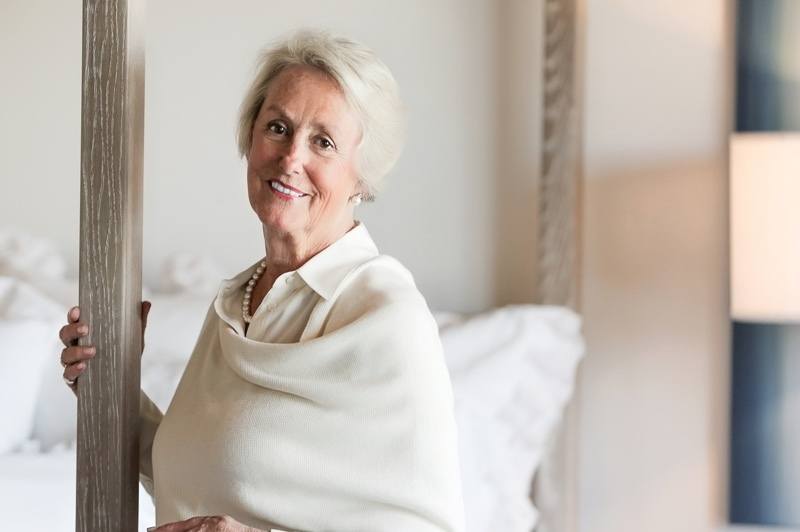
When she became a mom and was edged out of a traditionally male career, Mary Ella Gabler took to the sewing machine ... and built a multi-million dollar linen business. Today she's inspiring us as our FACES of the South.
The question of whether women can be simultaneously successful at work and at home has been hotly debated for decades — even before journalist Anne-Marie Slaughter opined that women can’t have it all and Facebook COO Sheryl Sandberg disagreed, admonishing working moms to simply Lean In. But instead of choosing a side in the never-ending mommy wars, women like Mary Ella Gabler choose to fight mercilessly for both career and family — holding their children close while quietly building an empire. Here, the founder of the multi-million-dollar luxury linen company Peacock Alley discusses her path from Wall Street to bedrooms across America — and what it means to have her sons along for the ride. Welcome her as today’s FACES of the South!PinMary Ella Gabler, founder of Peacock Alley and today’s FACE of the South
What was it like being a woman on Wall Street in the ’60s?
I thought I was going to move to New York after getting out of school and join the airline but I wasn’t hired. So I ended up meeting these people in New York and they worked down on Wall Street. That’s how I ended up working on Wall Street and, through this aggressive group of young men, I went to the New York Institute of Finance and became one of the first women to be a registered representative in the early ‘60s.
We are grateful to all our sponsors:
Did you ever experience any discrimination?
No. I really didn’t run up against any of that. And I didn’t think of myself working in that industry as a woman, either. I was just trying to pay the rent.
Pin
Then you moved to Dallas, Texas, because you got married. Was that a difficult transition? Did you find yourself thinking, “What am I going to do now?”
Well, when I moved to Dallas, no one wanted to hire me and that was really when I first felt the old-boy system in the financial world. So I was just very involved with motherhood for the first couple of years. And then, because I loved work — I loved just doing something else and feeling good about what I was doing — I started Peacock Alley. It started from just seeing some really cute boudoir pillows in a store; and it was at a time when we all had home sewing machines, and you would say, “Oh, I can go home and make that.” That’s how it started: from a little boudoir pillow.
Is there any other inspiration behind Peacock Alley?
Well, I grew up in Pennsylvania Dutch country, and my mother and my grandmother had this love of quilts. They made them; I lived with them. I have such fond memories of climbing into those farmhouse beds and it just made more of an impression on me than I certainly realized, for years. When I started out with pillows, though, I did not have a vision of the company that has developed. But it was just through contacts and taking the opportunities that I had along the way, and just putting one foot in front of the other.
PinMary Ella says that being known for neutrals is what sets Peacock Alley apart from other home and bedding lines.
Your kids were 1 and 3 years old at the time. How hard was it to start your company with small children at your feet?
Well, when I started it, it was just about being at home with my children and sewing those first pillows on my home sewing machine. So until I had every room in the house full of pillows, I stayed at home. And then it just got to be too much. And I got my first order from Neiman Marcus, so that really forced me into doing something other than staying at home.
For people that are not familiar with the brand, what is the key distinguishing factor — or maybe a few factors — that separate Peacock Alley from some other home and bedding collections out there?
Early on, we started with a white bed and I think, over the years, just being known for neutrals sets us apart. I think what we do at Peacock Alley that differentiates us is that we really work at the “little black dress” theory. We just layer on — each new collection builds on something that we’ve already developed in the line — but we are really known for classic basics that are neutral. I think our customers today are looking for a restful, comfortable bed. You just want some quiet in your life and I just think there’s nothing more soothing than climbing into a wonderfully made, clean, serene bed. And the soft neutrals kind of perpetuate that peace and serenity.
PinMary Ella authored “Uncommon Thread,” which chronicles her life and offers the pearls of wisdom she’s picked up along the journey.
Your two sons have since taken over the day-to-day operations of the company. So, how involved are you today, in terms of design and new product development?
I have transitioned the business over to my sons and they are running the operation of the business today. It’s interesting working for your sons but they are very open to my staying involved in the product development because that’s been my big love over the years. They also realize that I’ve been around in this industry so long that I have really close relationships with accounts — and I love being with the accounts — and they find that valuable for Peacock Alley.
What are some of your favorite Peacock Alley products?
I’m passionate about an all-white bed or mixing in neutrals with the white. There’s a coverlet that’s called “Juliet” that I love. I love putting three or four different textures together on a bed. I have a collection of antique linens and they’re all white-on-white embroideries, and I love mixing that in, too. Personally, I’m less frilly.
Pin
You also have a book now called “Uncommon Thread,” and it’s gorgeous but also packed full of life lessons. What inspired you to write it?
When I started on this mission, it was going to be a really pretty coffee table book because we had such nice photography at Peacock Alley. That was a couple of years ago and there was such a flood of coffee tables on the market; but when I was discussing it with the boys, they said, “Mom, just tell your story.” So that’s really what it is: from when I got out of school and moved to New York, to the real adventure of starting a business from scratch and growing it — the ups and downs, and I’ve had plenty of them. I hope that it’s inspirational and from the feedback that I keep getting, I think it is.
So what advice do you have for women who are trying to juggle small kids with the desire to start a business?
There’s a quote in the first chapter of my book: “Success is not final. Failure is not fatal. It is the courage to continue that counts.” And I think that says a lot. You just keep going. I wish I had more words of wisdom than that but I just think that if you’re really committed and you love what you do, you just keep pushing to make a difference.
PinMary Ella credits a childhood climbing into big farmhouse beds with homemade quilts as a key reason she launched Peacock Alley. “It just made more of an impression on me than I certainly realized, for years,” she shares.
Aside from faith, family, and friends, what are three things that you can’t live without?
Working in my garden, fresh flowers and ironed sheets. It’s the way I grew up and it was my job, on Saturdays, to put the sheets out on the line and bring them in and iron them. And I just love the feeling of getting into freshly ironed sheets!
You’re not ironing them yourself though …
No. I have them ironed, today. But I’ve ironed plenty of sheets over the years.
Thank you, Mary Ella, for offering us a look into your background and sharing the wisdom you’ve gleaned over the years. Thanks to Leila Grossman of Grannis Photography for today’s beautiful photography of Mary Ella taken at Peacock Alley in Nashville, Tennessee.
**********
Keep up with the very best of Southern life — follow us on Instagram at @StyleBlueprint.
Andrea is a Styleblueprint editor, veteran journalist and published author. She lives in Nashville with her husband and four children and is always on the lookout for the next great story.
Our unofficial motto at StyleBlueprint is "Be kind. Do good." We encourage this to be the basis for all comments on our articles. Provide feedback that adds to the story. Some controversy or disagreements are part of any good dialogue between friends, but anything that tears down or belittles others is subject to disapproval or removal. Thank you for being a member of the StyleBlueprint community! View our Community Guidelines.