

Have You Ever Heard of the Nashville Nine?
Through its annual "Nashville Nine" program, Historic Nashville, Inc. preserves some of the beautiful buildings and landmarks that tell our city's story. Find out more about three of this year's landmarks that the group is working to save.

The growth of Nashville is bittersweet. As we welcome new residents and local businesses, we bid farewell to longstanding pillars of our city’s history that haven’t survived the evolution. Thankfully, Historic Nashville, Inc., preserves and rehabilitates some of the endangered historic buildings and culturally significant sites across Music City. Through the nonprofit’s Nashville Nine program, which advocates for protecting local properties in danger of demolition, neglect or ill-suited redevelopment, they’ve successfully saved prominent landmarks such as Union Station, the Ryman Auditorium, and the Shelby Street Bridge. In one instance, Music Row’s famed RCA Studio A was purchased by a preservationist only hours before it was scheduled to be decimated by a wrecking ball and replaced by luxury condominiums. The annual Nashville Nine list is chosen by public nomination and voted on by a committee, and the 2020 nominees are memorable, greatly influenced by the pandemic, the March tornado and civil rights struggles. Today, we’re shining a spotlight on three of them, but you can view the full list and learn more about the other six properties HERE.

The Eldorado Motel Sign
2806 Buchanan St., Nashville, TN 37208
The Eldorado Motel landmark isn’t just a “cool sign.” Sitting back from the road at 2806 Buchanan Street in North Nashville, the eye-catching mid-century neon marker is all that’s left of the Green Book-listed Eldorado Motel. Though the lodgings fell into disrepair and were torn down in 2012, the motel’s historical importance remains — it was opened in 1957 by George Driver and Bill Otey, the first Black business owners to receive a Federal Small Business Administration loan in Nashville. “A lot of folks in the civil rights movement stayed there when they couldn’t stay in hotels downtown,” says Historic Nashville, Inc.’s president, Elizabeth Elkins. “Dr. Martin Luther King, Jr., stayed there during the Southern Christian Leadership Conference in the ’60s, and Ted Rhodes, who was the first Black professional golfer, actually lived at the hotel late in his life. There’s an adjacent golf course right beside where the motel was.” That, of course, is the Ted Rhodes Golf Course.
A significant reminder of the importance that the neighborhood played in the civil rights movement, Historic Nashville is looking to restore the sign, light it, and put up a historical marker to further educate people about what happened there. “This year, in particular, we started discussing [the Nashville Nine] during a lot of the protests this summer,” says Elizabeth. “We wanted to have some actionable things tied to the importance of telling Black stories in Nashville. So, we decided we were going to focus the majority of the Nashville Nine on that and put some money behind it rather than just make a statement.”
On an even grander scale, they hope the Eldorado Motel sign will be a noteworthy stop on an extended trail that will tell Nashville’s civil rights story. “A greater hope for it, and something we’re working with the city government on,” explains Elizabeth, “is to try to get a National Civil Rights Trail started so you can visit different sites along the route and learn more about these stories. We hope this motel sign will be part of that trail.”
Perhaps unsurprisingly, the obstacle in getting the Eldorado Motel sign back up and running comes down to lack of finances. It’s an expensive undertaking, with the restoration alone costing close to $30,000. “We’ve actually gotten several quotes from some of the better neon restorers here in Nashville,” Elizabeth tells us. “You’ve also got to light the sign, so there’s a cost for electricity. My vote — my opinion — is that I hope we can get the city electric service to donate the power to it.”

RELATED: 42 Positive Moments From 2020
The Z. Alexander Looby House
2012 Meharry Blvd., Nashville, TN 37208
A civil rights attorney and activist, Zephaniah Alexander Looby taught at Fisk University, led the fight for school desegregation, and was elected to the Nashville City Council. He defended a number of students arrested in the Nashville sit-ins to end racial segregation at lunch counters, which led to his home being bombed in April of 1960. Mercifully, both Zephaniah and his wife survived, but it left a lasting impression on the neighborhood and Nashville as a whole.
That’s the history in a nutshell, but to see the house is to catch a sobering glimpse of the civil rights struggles that have plagued America for generations. Historic Nashville is looking for the Z. Alexander Looby House to serve as the headquarters for their future Civil Rights Trail, and for a good reason. “To me, the Looby house is startling,” says Elizabeth. “The house that was bombed was more of an early century Craftsman home, and you can see the reactionary architecture to the bombing. What’s left of the house that was bombed is just the stairs leading up to it.”
In fact, the bomb — which consisted of dynamite bundles — caused so much damage that Zephaniah and his wife rebuilt the residence altogether, taking every preventative measure they could think of to protect themselves against future attacks. “It’s built like a ship,” explains Elizabeth. “The windows are up really high to prevent a bomb from going directly at them, and the edge of it is pointed like the bow of a ship. The front door isn’t on the street anymore; it’s terrifying to think, but it is really a study in how to protect your house from being bombed while you’re sleeping at night.”
The more recent incarnation is a brick, mid-century house on a vacant lot that appears to be part of the Meharry Medical College. In reality, the Looby house is on privately owned property. Historic Nashville hopes to partner with the owners to find a way to share the building’s narrative — an impactful one in Nashville’s past. “I’ve heard the Mayor say that Looby is our most important Nashvillian,” offers Elizabeth. “That story is almost the center point of everything that was going on with the sit-ins and the civil rights movement in the early ’60s. At the same time, you’ve got the interstate being built right through the middle of that neighborhood, so it’s a complicated time. The story of what happened to Looby and his career as an outstanding attorney and civil rights activist … there’s a lot to talk about with the house.”

RELATED: The Hidden History of Marathon Motor Works
Hopewell Missionary Baptist Church
908 Monroe St., Nashville, TN 37208
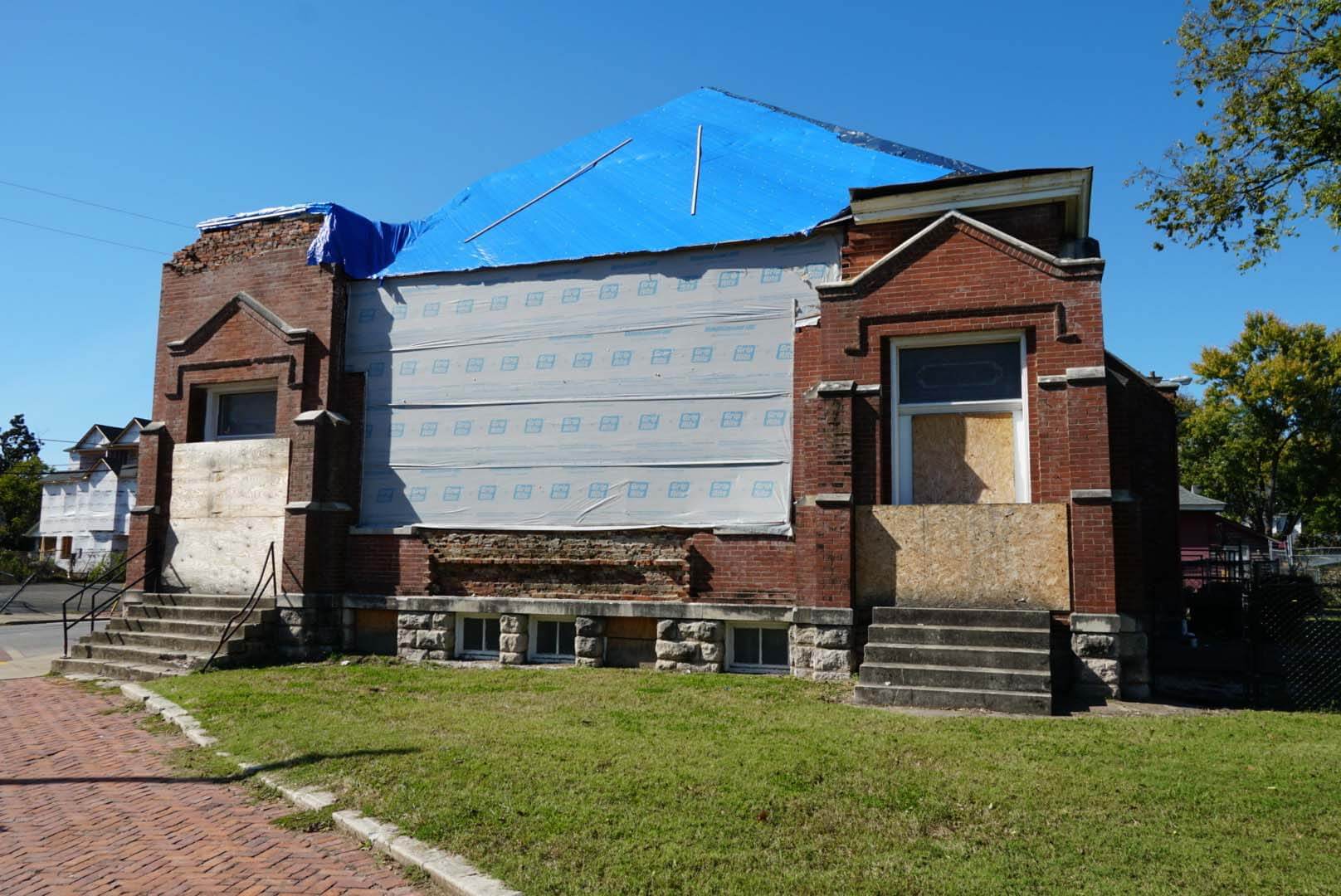
Though the Historic Nashville committee put much of their focus in 2020 on buildings related to the civil rights movement, there were several other factors they took into consideration. “We’re a city of songwriters and musicians and all kinds of music,” explains Elizabeth. “So we looked at the pandemic and its effect on venues, and we looked at damage from the March 3rd tornado, which obviously happened days before the pandemic shut the city down.” Hopewell Missionary Baptist Church earned its place on the list when it fell victim to the latter — the second time it has sustained tornado damage in the last 25 years. “It is symbolic of the devastation that the tornado had, and the fact that a lot of the attention for the tornado damage has gone to East Nashville and Germantown,” Elizabeth tells us. “Some of the other neighborhoods that have gentrified have the resources to repair and rebuild, whereas North Nashville was hit with equal devastation, and in many cases, folks didn’t have the insurance or financial means to rebuild.”
Sadly, the church was so severely impacted in the storm that parishioners are unable to worship within its walls. The steeple was entirely lost to the storm, and the sanctuary is currently padlocked and boarded up until recovery efforts can be made. But even beyond the temporary patches and protection from the elements, it’s easy to recognize the church’s architectural importance — it’s a beautiful Gothic building designed by Swiss architect Henry Gibel, who moved to the city in the mid-19th century and had a hand in designing other local treasures such as the Nashville Arcade. The majestic church was even added to the National Register of Historic Places in 1979.
“This is a building that has been the center point of a very interesting neighborhood culturally — it’s Germantown meets North Nashville, right near the Rosa Parks and Jefferson Street intersection. It has a long German immigrant history, and then it has a history of some of the first Black businesses in a vibrant Black neighborhood in Nashville,” shares Elizabeth. “It’s been a Baptist church since the early 1900s. It’s not as complicated as some of the other ones; they simply need money to rebuild.”
To learn more about Historic Nashville, visit historicnashville.org. All photos courtesy of Historic Nashville, Inc.
**********
For your daily dose of StyleBlueprint sent straight to your inbox every morning, click HERE!

Jenna von Oy Bratcher
Jenna von Oy Bratcher is StyleBlueprint's Editorial Operations Manager and Lead Content Editor. The East Coast native moved to Nashville almost two decades ago, by way of Los Angeles. She is a lover of dogs, strong coffee, traveling, and exploring the local restaurant scene bite by bite.