
5 Things You Need to Stop Saying
Do you want to feel more empowered? Small but mighty, some words we use on a daily basis have a profound effect on how others perceive us — and we're all "guilty" of using them.
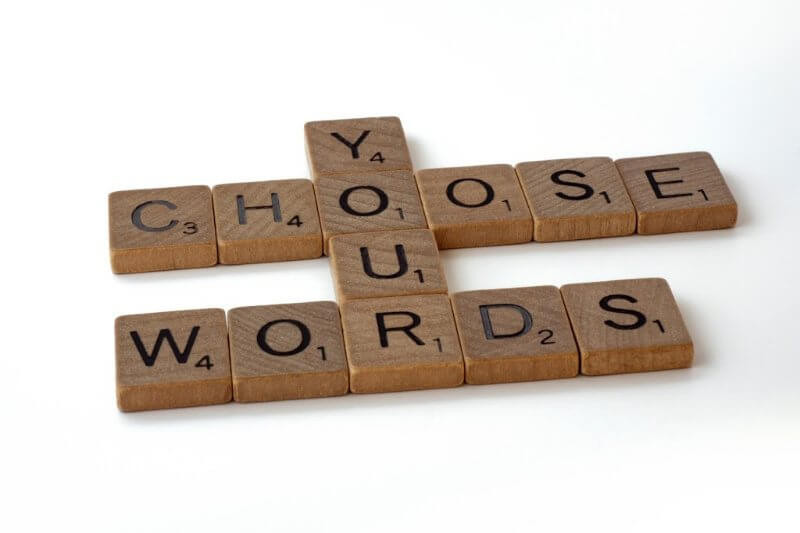
Our words carry energy. They are the most influential tools we possess in our everyday arsenal, and they have the ability to either limit or liberate us. And, while they may appear harmless, certain expressions can shift people’s perceptions of us — in some cases, zapping our authority in nanoseconds. So, at the risk of making you overthink everything you say aloud, we’re breaking it down. Here are five phrases to stop saying in order to feel more empowered.
“I’m sorry.”
How often do you catch yourself apologizing? When someone bumps into your shopping cart in the middle of the supermarket produce aisle, is your knee-jerk reaction to blurt out, “I’m sorry!”? If someone blocks your path because they’re too busy obliviously chatting on their cell phone, do you immediately jump to, “I’m sorry, can I get by you?” We’re all guilty of it — reflexively apologizing when we aren’t at fault for anything. In both of the aforementioned scenarios, for example, “I’m sorry” could be substituted with its less blame-taking sister phrase, “Pardon me.” The result? A polite remark or request that replaces an unwarranted apology.
To be clear, we aren’t suggesting you should never again use the words I’m sorry. Showing empathy and owning our actions, especially if we’ve hurt someone, is a fundamental part of life. It’s also the right thing to do! Here at SB, we stand by the slogan, “Be kind, do good.” However, constant apologies systematically belie our power and self-confidence, especially when the words I’m sorry precede our relevant and worthwhile opinions.
In recent years, there has been a surge of encouragement for “unapologetic” living, especially as it pertains to women. There have been books and even comedy skits written about the topic. In an interview a few years ago, when asked to recount something she’d learned during her most recent project, actress Amy Schumer answered, “I discovered not to apologize before putting my two cents in.”
RELATED: Top 10 Books for Fall 2019: What We’re Reading Right Now
The fact is, you shouldn’t feel bad for contributing your viewpoint, doing your job or meaning business, right? So what’s our hangup? The running theory is that we’ve been conditioned to be polite and avoid conflict, so “I’m sorry” has become an ingrained, roll-off-the-tongue comeback — even when other responses might be more appropriate. No one relishes the idea of being seen as rude or insensitive, so sometimes, we overcompensate in the opposite direction.
It even applies to trivial matters. Take a trip to your local coffee shop, for example. You wait 15 minutes in line to order a plain iced latte, and when the barista hands you your drink, it’s piping hot and has an overdose of vanilla syrup. Sure, you could keep your mouth shut and simply be thankful you’re getting your much-needed caffeine fix; instead, you say, “Excuse me. I’m so sorry, but this isn’t what I ordered. Would you mind remaking it?” The question becomes: why are you sorry for the mistake someone else made? Accidents happen — that poor barista probably remakes drinks all day long. And it’s just a cup of coffee, after all! But whether it was a 50 cent coffee or one of the high-end brews that takes more out of your paycheck than dental insurance (which you’ll likely need in spades if you stick with all of that vanilla syrup), you deserve to get what you asked and paid for. And why be sorry for that?
Our advice: Employ some verbal mindfulness and be polite without the apology. #GOALS. Oh, and the next time you begin a conversation with, “I’m sorry to bother you,” try switching gears. Own your valuable input and confidently bring it to the table!
“… But …”
This three-letter word is a staple in our vocabulary, and nearly impossible to avoid. But its placement makes the difference — it’s all about context. Following an idea or opinion, “but” often negates or detracts from whatever came before it. Consider this sentence: “I would love to have quiche for dinner tonight, but I’m good with whatever you choose.” Why not stick to, “I would love to have quiche tonight.”? Your opinion matters. If someone differs, we can only hope they’ll speak up about it — let the friendly dialogue ensue! Meanwhile, adding “but” suggests your thought or feeling isn’t as valid as someone else’s. And how about when you tell your spouse or child, “I love you, but it drives me crazy when you leave your clothes all over the floor.”? Saying “I love you, but…” takes away from the expression of affection and inadvertently makes it sound like seeing clothes on the floor somehow detracts from the love you feel — which we’re pretty sure isn’t what you were going for!
Our advice: Express yourself proudly and with conviction, and cut the “but” if it throws shade on the sentence before it.
“No offense …”
It’s the disclaimer of all disclaimers. A micro-expression meant to soften the blow, saying “no offense” most often results in putting someone on the immediate defense instead. It typically sets up the expectation of criticism and highlights whatever it is someone might be offended by. For example, you tell your sister-in-law, “No offense, but I don’t think those shoes match that skirt.” It seems relatively innocent, right? The intention is honesty without hurt feelings (we hope), and chances are, you are saying it to someone who knows you have good intentions — in this case, a family member. But most of the time, we use those words when we know we’re about to say something inflammatory, and the receiving party knows that too. Beginning an opinion with “no offense” doesn’t remove our accountability when it comes to hurt feelings. (Especially as it pertains to in-laws.) Kind and candid can undoubtedly co-exist with thoughtfully chosen words, so saying “no offense” should be unnecessary.
Our advice: Concentrate on being constructive. If you know you’re being fair, respectful and truthful, there’s no need to add a pre-emptive buffer. And if you’re still tempted to use the term “no offense,” consider whether your statement might be better left unsaid.

“Honestly” or “To tell the truth”
When we begin a sentence with the words honestly or to tell the truth, it unintentionally implies that we weren’t being honest before. Since there are few things more important than being able to take someone at their word, whether in a personal or professional capacity, this can be a massive detriment to the impression we make. For the most part, those terms tend to be utilized as a sentence segue. Much like “I mean … ” or “Well … ” they don’t necessarily serve a purpose or enhance our point. And they are usually offered as a way to preface harsh truth, as in, “Honestly, I think velour tracksuits should have stayed in the ’80s.”
Our advice: Be honest but skip the “honestly.” Don’t devalue your integrity by beginning your sentences with a term that conveys mistrust.
RELATED: Glennon Doyle Melton: FACES of the South
“Just”
Padding our vocabulary with the word “just” can dilute our objective. It often takes on the role of a filler word, making our point seem less impactful or suggesting we should feel bad for something. Picture this scenario: You have cherished friends coming over for dinner, and you’ve spent hours following a complicated recipe so you can serve a thoughtfully prepared meal. Your guests take one bite and begin praising your culinary skills, gushing over how delicious it tastes. As a response, you say, “Oh, thanks. It’s just a recipe I found online.” In that instance, “just“ becomes a way to deflect the compliment, giving up ownership of the effort you’ve put in. Being humble is a beautiful thing, but it’s okay to acknowledge that your work has merit too!
Sometimes just can also take the form of an apology or suggests insecurity. For instance, examine what happens when you tell a coworker, “I know you’re busy; I just wanted to give you a copy of tomorrow’s sales pitch.” The “just” makes it sound as though you feel bad for interrupting — even though you’re doing your job.
Our advice: You aren’t just another member of your home or office. You’re worthy, respectable and valuable, so don’t sell yourself short.
Honorable Mention: The Exclamation Point!
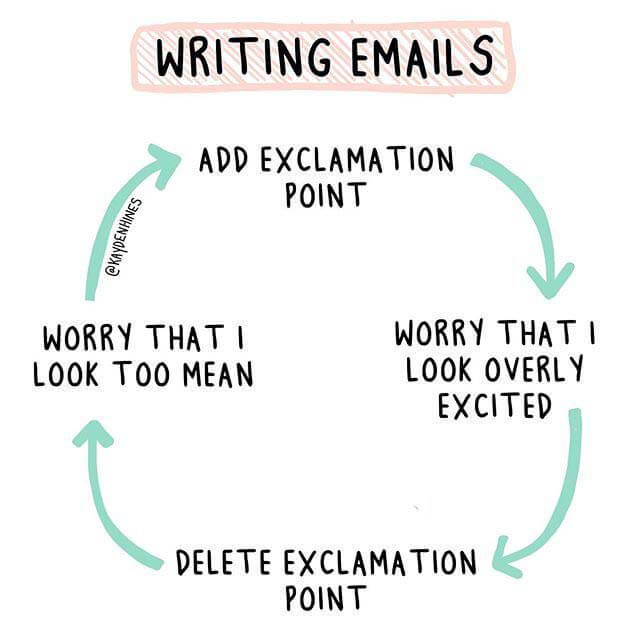
We know, we know, we said, “five phrases.” But we can’t ignore an oft major culprit in our writing, so we’re granting honorable mention to the exclamation point — punctuation, which, when used sparingly, emphasizes excitement or urgency. But what happens when we use it excessively?!!! Everything seems so dramatic!!! Our sentences appear overwrought with big feelings!!!!!! People take us less seriously!!!!!!!!!!!!
See what we did there?
Using too many exclamation points can make it sound like we’re about to self-destruct, so curbing our punctuation enthusiasm, particularly when constructing work emails, is one way we can present ourselves more professionally. The conversational nature of the exclamation point certainly has a place in our texts, Instagram posts, personal emails and even hand-written letters. After all, how boring would it be if every sentence ended in a period? But employing the exclamation point too liberally can stifle its impact and make people feel like you’re shouting at them from the page.
Our humble advice: Refrain from excessive use of exclamation points, particularly in more formal correspondence. Consider how to get your point across without overzealous punctuation. Sometimes subtlety is a good thing.
In conclusion, we’re sorry if we’ve made you overthink your everyday vocabulary, but we just wanted to draw your attention to some conversational pitfalls!!!! Scratch that.
Let’s try this ending instead:
In conclusion, we hope we’ve shed some light on a few conversational pitfalls you can avoid, in order to feel more empowered. Now, take your newly adjusted vocabulary and go spread some self-confidence!
**********
For the best of the South — straight to your inbox! — subscribe to our newsletter HERE!

Jenna von Oy Bratcher
Jenna von Oy Bratcher is StyleBlueprint's Editorial Operations Manager and Lead Content Editor. The East Coast native moved to Nashville almost two decades ago, by way of Los Angeles. She is a lover of dogs, strong coffee, traveling, and exploring the local restaurant scene bite by bite.