Meet Two-Time Paralympian Karin Korb
Karin Korb was a competitive gymnast until an accident left her paralyzed. Now, she's a two-time Paralympian and an access advocate with Lakeshore Foundation. Meet this motivated and dynamic FACE of Birmingham.


Tell us more about the work that you do for the Lakeshore Foundation.
My career in both advocacy and policy has spanned over three decades. I’ve worked with Lakeshore Foundation’s Lima Foxtrot program for injured military since its inception, and in 2016 I moved to Birmingham to serve as Lakeshore Foundation’s Policy and Public Affairs Coordinator. In this capacity, I lead the Lakeshore Foundation’s Leadership and Mentorship Program, coordinate the Global Sports Mentorship Program collaborative with the University of Tennessee’s Department of Sport, Peace and Society and the U.S. State Department, and serve as an advocacy and policy liaison to many local, national, and international board and advisory groups. So often these decision-making spaces in the public health sector omit representation of those with a disability. One day, someday the inclusion of disabled people will not be an afterthought. My work really is 24/7. As a person who lives the experience, I don’t go home at 5 o’clock and the job ends. There is a choice I have made to be a part of the never-ending commitment to facilitating change. Basically, whatever needs to be done and then some is what I do. There’s an urgency inside of me because I live with privilege. I see how many doors are opened for me because of my skin color and what I look like and how I’m able to articulate larger concepts. To whom much is given much is required. I really believe that. The empathy that I have for my brothers and sisters who don’t have access is what drives everything.People with disabilities are one of the least represented groups in the media. Do you think this lack of representation is one of the causes of the lack of access?
All roads lead back to the lack of real diversity. Right now it’s very trendy to talk about diversity, equity, and inclusion, but the D in diversity is disability, and no one wants to include that. Race, gender, and sexual orientation are the “usual,” but what most organizations don’t realize or address is that both visible and invisible disabilities intersect all the protected, marginalized, and vulnerable populations.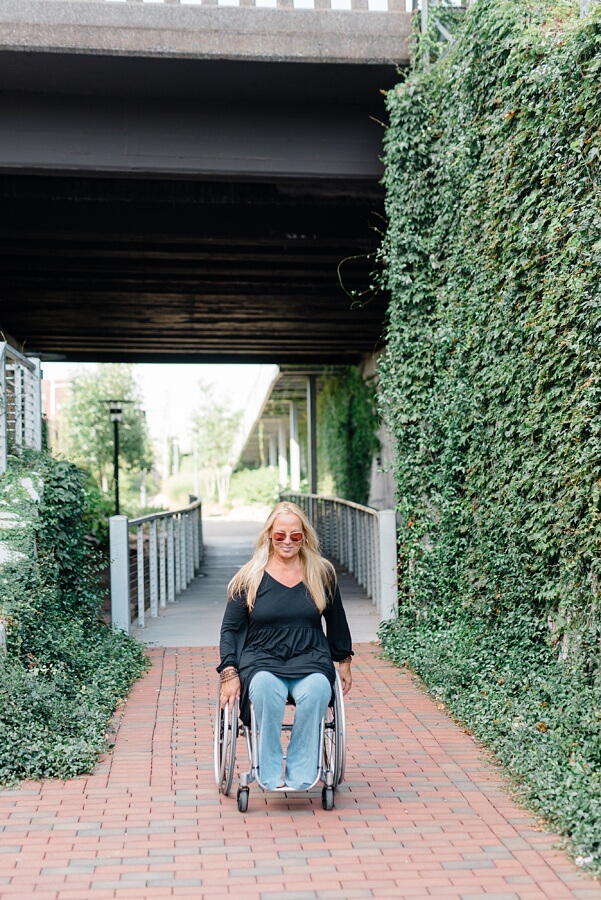
What can our readers do to help this cause?
As with any other social justice movement, one of the things that readers can do is foundational work in this space. Read poignant articles authored by disabled people. You will learn that being disabled is often seen as a prideful identifier, as a culture, and not as “inspiration porn,” as Stella Young says in her TED Talk. People, generally speaking, have such implicit biases around disability that they can’t see that you’re a whole person because they’re so enamored that you’re out of your house today. Do some of your own educational lifting and not rely on the emotional labor of those who do this work or live this experience. Stop using euphemisms! I am disabled or a person with a disability; I am not “differently-abled” or any other made-up name to dilute disability culture.What can companies and organizations do to help?
Check your diversity, equity, and inclusion policies. Do you have one? What does your workforce look like? Yes, I am aware that you have a beautiful parking spot for us, but can we work at your organization or company? Does your board of directors have someone that identifies as disabled who has something of value to contribute — not just tokenism? Organizations can also take the “Commit to Inclusion” Pledge. We are still in a population where those without disabilities are in leadership and making decisions about us and for us and not with us.
What are some of your favorite things to do in Birmingham?
I love pushing on the Rotary Trail and Railroad Park and, of course, playing tennis. I study pranic healing, esoteric and metaphysical practices, and meditation, so I frequent the Birmingham Shambhala Meditation Center.Do you have any favorite restaurants in Birmingham?
I love anything from Golden Temple. I like the Thursday night diver scallops at Blueprint on 3rd, and currently on their menu they have baked oysters with apple smoked bacon, creamed spinach, Parmesan and crisp bread crumbs — so delicious! And their waitstaff is one of the most culinary-educated in the business. At Ovenbird I’m in love with it all, except the meat dishes because for the most part, I focus on a plant-based way of eating. Bamboo on 2nd never disappoints. I live by Pepper Place so I can push to Blueprint on 3rd and Ovenbird. Walkable/moveable communities are my universally designed dream world, and our city of Birmingham is moving in that direction. People spend money, not cars, so if we can access places and spaces without getting into our cars, we get our “steps” in and we can create additional economic impact. RELATED: Your Itinerary for a Perfect Saturday in Pepper Place Entertainment District
What’s the best advice you’ve been given or the best advice you have to give?
One of my first mentors, Deidre A. Davis, Esq., a powerful disabled black woman, once said to me, “Don’t ever forget where you come from and all the people, places, and things that helped get you where you are.”Not including family or friends, name three things you can’t live without.
My wheelchair, my two cats Soham and Kwan Yin, and me-time to get my nails done by Karneshia Shantel of Shantelz Nailz. Thank you, Karin. And thank you to Eric & Jamie Gay of Eric & Jamie Photography for the beautiful photos of Karin.**********
Subscribe to StyleBlueprint to get more amazing FACES profiles every week! Click HERE!
Javacia Harris Bowser
Javacia Harris Bowser is a Birmingham-based freelance writer and the founder of See Jane Write, an online community and coaching service for women who write. With over 20 years of journalism experience, Javacia has received awards from the National Federation of Press Women, Alabama Media Professionals, Alabama Press Association, and the Alabama State Council on the Arts. When she’s not writing, she’s usually practicing Pilates, getting her 10K steps a day, or watching crime shows. Follow Javacia on Instagram @seejavaciawrite.